Thursday, 26 May 2011

MORE SPARKS FROM GEBLER'S ANXT...


Blogger has graciously arranged to return the discussion comments that followed a post sparked by a recent article by Carlo Gebler, entitled in part What You Might Lose By Becoming a Writer. Add them to the coments that peeps kindly rewrote - and we have quite a flood of thoughts from writers of all kinds, reacting to his somewhat depressed ourpourings. Makes interesting reading for any writer. Do we really know what we are getting into?
Post and discussion is here...

Tuesday, 24 May 2011

THE STORY OF A GARDEN

Driving into Brighton along the Lewes Road, you are driving through a community. Endless little shops. Things for sale displayed on the pavement, passing by in a blur when the lights change. Caffs. A small funeral director on each side of the road. Glimpses of terraced streets running to the left, the right. Bus stops. Kids. A church or two - a hall, Mums pushing buggies into a porch, going somewhere good. Furniture shops - second hand and new. Launderette, I expect - although I might have made that up...Not a lot of green. A few trees struggling to hold their heads up... and quite a way further on, past the intersection with Elm Grove, a wide space, the levels, a park where the fair sits down for a rest once a year, otherwise it is one of Brighton and Hove's lungs, green and peaceful - kind of - as peaceful as you get in Brighton.... Tall tall old trees, with gracious and rather lovely regency terracing overlooking....rather different to the street you've just driven down.

Back on Lewes Road, between two of the side streets there was a patch of derelict ground. An eyesore. A place where maybe you wouldn't want to walk barefoot... certainly wouldn't want to let your kids play...It had been like that for a very long time. Various 'For Sale' notices appeared now and again. Then one day, things changed. On the earth, a chair or two. A painted table. Then some raised beds - a notice declaring this a Community Garden - making use of a dead space for a while - always people there, kids, people growing things, somewhere to meet, colour, sound, and it was funny to watch how people like me, who were only passing through in their cars, slowed down to look - glimpse something nice...it lifted the spirits.


Growing things on a bit of borrowed ground - sounds idyllic...until the owners of the site took the gardeners to court. And the gardeners attended court unrepresented...not that that would have made a difference, probably. This was the outcome.


I was particularly cross to hear someone saying the ground was contaminated... and that's why they were pulling the garden down. What rubbish. The diggers and bulldozers, driven and organised by workmen wearing not one mask between them... fling the earth (much of it topsoil brought from elsewhere for the raised beds) high in the sir, scattering dust far and wide. If there were contaminants, they are sure as hell in the lungs of the locals by now.
Cost of destroying the garden... a lot.
Cost of creating the garden... nil.

Sad. We all lose out when things like this happen.
Pics from HERE and from the Community Garden's own website, complete with lovely gallery - where you can read the whole story...HERE

Sunday, 22 May 2011

ARE MFAs/MAs "RUINING FICTION"?


'Are MFA Programs Ruining American Fiction?'--- and by extension, are all writing progs ruining fiction in general? That is the title of an article I read recently. My reply? Nah of course they are not - on the contrary, they are encouraging, and helping, and honing.. aren't they - anything that brings new writers to publishers is good, if you ask me. But it is an interesting debate, isn't it? How do you mark manuscripts without imposing some criteria? I'm sure, if a student is clever, and wants to get good marks, they submit work they know fits the criteria, whether or not they intend to write like that in future. I'd love to reproduce an email from a fab young writer of my acquaintance, frustrated but amused at having to send in work they would 'not write off my own bat in a million years, and never will again' - However - I digress. That's the system, and if you want the qualification, you play the game. And you learn, despite yourself, probably, on the way. And my fab young writer may well be taking in all sorts of things that will feed the communication of all her amazing creations at a later date. But the article underlines a truth - you can be taught all sorts of craft - how to make your prose fine and dandy - but no one can teach your brain to come up with interesting and original stuff. Can they?
Article is in full, HERE
Here are some quotes....


“MFA grads with nothing to say are now able to say it more skillfully, (HA!! love it!) but authors were pretty good at being boring before university writing programs came along and would surely go on being boring if every MFA program were wiped off the face of the earth. The programs don't make them dull, even if they also can't make them interesting.”
“Lucidity, striking word combinations, evocative descriptions, inventive metaphors, smooth transitions and avoidance of word repetition, does not necessarily lead to more interesting or appealing books.”
“Anything that helps good writers publish more good books is fine by me, and the programs at the very least provide teaching jobs for talented authors who might otherwise have difficulty making a living because their work is insufficiently commercial..”


Really interesting article – very thought provoking, and I enjoyed the read because it does not come down heavily one way or the other but gives a good overview of arguments for and against.
Read, inwardly digest and discuss away then. But here are my own views...
I am slightly interested in the assertions in author bios that they have a degree, masters, M Phil, PhD, or something else, in Writing – mentioned as if it gives weight to the work that would otherwise not be there. Maybe all it is saying is ‘My work has been found worthy by others, not just my Mum’, a bit like listing publications and other successes. Or maybe I am jealous – but I don’t think so. I AM however, very jealous of the company they kept for a few years. I AM jealous of the space they had - both actual and metaphorical - to write, the permission to create, the synergy that builds up in a group of writers, the tussle, the buzz, ideas flying, the challenges thrown out from their peers and betters. The opportunities and permission to discover and try new things. I AM also jealous of the network opportunities missed, because as we all know, in this game one helluva lot depends on contacts. And to teach at a university, one needs to have a university qualification - and so the circle tightens...However.
I know many writers who teach at the highest level, have worked with some and found them extremely exciting and inspirational teachers- and would love to spend regular time with them, chewing over craft issues, discussing a piece of contentious work – published or not - and I almost did just that, once, some years back. But it didn’t go as planned.
The truth is, that had I stayed on a well-respected course, I would not have written ‘The Coward’s Tale’, as I was told not to, and for me, not writing it and doing something more acceptable for the course, wasn't an option.

But I am therefore completely unqualified in Creative Writing. But please note, I am not unqualified to write. Or to create.

.

Thursday, 19 May 2011

'THE COWARD'S TALE' HAS A MAP!


Copied from The Coward's Journey Blog, linked over there somewhere, where I am following all the stages to publication in November...Brilliant! Now I know where I am, and where I''m going. I have a map - and so do my characters. It is very interesting, as I said before, and none too easy, to create a map of a fictitious place. It made me see where characters had turned right to go left, if you follow me... (I wouldn't if I were you!) Beautiful, isn't it? All the main characters are located carefully, close to the place that means the most to them. So - clockwise from the top, you have:
Tommo Price, by the tunnel on the old coal line
Laddy Merridew, on the Brychan Estate (that's his gran's house...)

below them there is:
Icarus Evans in his caravan, surrounded by feathers

continuing round the edge, there is:
Peter Edwards, near Deep Pit (closed...)
James Little, by his allotment which he digs at night
Ianto Jenkins, the beggar, close to Ebenezer Chapel where he sleeps on a stone bench in the porch
Judah Jones, near the park where he finds silver leaves

moving left there is:
Factual Philips, at the Public Library, where he is Deputy Librarian and is probably reading The Collected Adventures of Sherlock Holmes on the quiet...
Tutt Bevan, the undertaker, off for a walk, soon,
Baker Bowen, in his house at the bottom of Steep Street, doing anything but baking

and at nine o'clock there is:
Matty Harris (and his wife Eunice, who will be red-faced with fury at being left off the map)
Mrs Bennie Parrish (who will be delighted to be included...)
Nathan Bartholomew, at The Cat Public House - where he's a lodger

and last but not least, for the last shall be first...
Half Harris, at 11 Maerdy St.


Bless 'em.

Wednesday, 18 May 2011

BRIGHTON FRINGE - FLASH FICTION SLAM, THIS SATURDAY, WITH DAMIAN BARR


Brighton Festival Fringe Flash Slam Saturday May 21st, 8 pm – hosted by the somewhat incomparable Damian Barr at Hendrick’s Horseless Carriage of Curiosities /– Jubilee Square, Brighton.

The Festival Fringe website says this...
The ultimate short short short short story competition! Well-known writers Niven Govinden, Vanessa Gebbie and Stuart Evers read their Flash Fictions aloud and judge yours! Strict rules apply. Your story must be 3 minutes or less. Your story must be entitled ‘the End’. Prize: £100. Free entry: names drawn randomly on night. Complementary decadent libation included
.
Damian Barr is a journalist, Radio 4 playwright, Host of the Soho House Literary Salon and cultural entrepreneur among other things...
Stuart Evers is the author of “Ten Stories about Smoking” (Picador) among other things...
Niven Govinden is the author of “We Are The New Romantics” (Bloomsbury) and Graffiti My Soul (Canongate)

Full details and booking info HERE >>> Brighton Fringe website

Sunday, 15 May 2011

Conundrums...


I am deeply indebted to Oscar Windsor-Smith for another coveted award - not only did I get an 'Oscar', a while back, but I now have a Versatile Blogger Award... thank you Oscar.
We are meant to pass it on to a million others, and also to divulge seven little-known facts about ourselves. The first I won't do - and if it's one of those things that visits at midnight and strikes one dead in one's sleep - so be it. The second, I guess I better had - or it would have been churlish to accept the award.

1. I once ate half a worm. My best friend ate the other half. It was a sort of bonding thing - we were six. I can let you know worms are very gritty. And a bit slimy too.
2. I had a common childhood operation at the age of seven. I smuggled my teddy into the room where I was sedated, no one noticed, and it came with me onto the operating table. Said teddy fell off said operating table in mid-operation. Surgeon was a father of small kids, and unthinkingly bent to pick it up... chaos ensued as he had to re-scrub...
3. I wrote my first play at 14 years old. Called "Randy Cilla and the Beautiful Sisters" it was a highly hilarious and rude reprise of Cinderella. The best character was Zipper (Buttons...?) or maybe it was The Hairy Godmother. I came close to being expelled from my boarding school for that masterpiece.
4. I had tea once with Dannie Abse. He was invited to the school to talk to us gels about being a poet. I informed him he wasn't much of one, because he said he threw his drafts away. I think we ate sponge cake.
5. My favourite short story, Cactus Man, written in 2004, explores what happens to the psyche of an adopted nice guy when he discovers his father was a rapist. Did that new knowledge allow a darker side of the bloke to manifest itself? In 2008 I discovered my own birth father could be a very violent man...so far, I have not developed psychopathic tendencies.
6. I used to bite my fingernails. I was told not to, as it was unsightly and unhygenic. I bit my toenails instead. Not to be recommended.
7. I often wonder about that worm...

Thursday, 12 May 2011

ON THE OTHER HAND – WHAT YOU MIGHT LOSE IF YOU BECOME A WRITER...

The mother of a highly successful writer sang her offspring’s praises to me recently – for writing the sort of “rubbish” (her word, not mine) that masses of readers want to read – said offspring earns a lot from their writing – but wouldn’t choose to read that stuff themselves as (quote) they “have standards.”

I did not sleep easily after that. My head was/is full of questions. What is the logical outcome of this... a highly literate, Oxbridge-educated (is this relevant??) writer who has chosen to write the kind of books they look down on as a reader?? Of course, they have a perfect right to do so. And every reader has a perfect right to read exactly what they wish. However. What happens to lasting literature if those who might well attempt to write it, never do because it makes them no money any more? But you don't need an education to be a writer of meaningful words, do you? I was churning over these conundrums in my head... and my continuing sleeplessness was fuelled by my recent reading of a fascinating and very sad article by Carlo Gebler – entitled “A Life in Literature – or What You Might Lose by Becoming a Writer”.

Here are a few quotes from this article. Comments from self at the end. And a link to the whole thing, which ought to be required reading on all CW courses if you ask moi.

Carlo Gebler:
In 1982 or maybe 1983, I published my first short story, called “The Speech of Birds.” ...The Literary Review paid me thirty pounds...I had come by publication honestly. I had worked hard. I had learned things, and I had put those things into practice. My interest in writing was also honest. I was a passionate reader.

I wrote all sorts of things. I worked as reader and wrote reports. I wrote novels. I wrote reviews. I wrote plays. I wrote scripts. I wrote all kinds of things. I made some money....I became a writer and teacher.

Today, I am 56. I hardly read any more. Not like I did....(There is) no time for the proper function of my imagination. ...That capacity has not been killed... my attitude has changed.

I never simply enjoy the act of reading anymore. My authorial intelligence is totally and fully engaged. When I read, whatever I read, I examine and analyze.

I read primarily to steal. This attitude applies not just to books but to everything. In every situation ... there is another part of my personality that is scrutinizing my experiences and thinking two terrible things: What’s in this for me? And: Can I use this? Can I put it in a story? Can I put it in an article?

I am also bitter. ...I am so fucked off with how the world has gone to the dogs and in particular that little bit of the world I think I care about most, which is the Kingdom of Literature...


Self – comments.
I am so saddened by the overall lack of joy here. The apparent self-harming low level of self-esteem in the ghastly admission that he reads now for money and ‘to steal’, not for enjoyment or for mental food. What has the writer's life done to the spirit of this man? The drift from the great pleasure of learning, writing better and better, becoming published, spreading one’s wings, achieving goals – and ultimately - the life of the writer as prisoner of the system. And a system he never meant to become part of, or agrees with.


The complete article is HERE on Some Blind Alleys

Tuesday, 10 May 2011

Looking for a writing group with tuition??


This is where I learned. It's called Boot Camp, for good reason. There's a special offer on, see below, message from the tutor.

Boot Camp numbers are currently on the low side so we are offering a new deal
to allow interested writers to try the BC experience.
The first four weeks free (no grid) to NEWBIES.
(The grid is a spreadsheet based on craft elements...)
Or (again NEWBIES only)
£100 up front for membership to the end of August (includes grid)
Please contact AK on alex.keegan
AT
btinternet.com
or go to BootCampKeegan on Yuku.com.

Thursday, 28 April 2011

GEARING UP FOR WEEK-LONG WORKSHOP IN IRELAND


SHORT FICTION at ANAM CARA 28th May - 4th June
The flights are booked, the car is booked, the ideas are flowing for creative exercises - and I'm told there are a couple of places left.. so forgive me if I put a bit of promo here! Don't read on if you are allergic to shameless adverts.
A chance to explore in depth the craft of short fiction in all its challenging guises, in one of Ireland’s most creatively exciting venues, Anam Cara Writers' and Artist's Retreat. A chance to focus on acquiring skills that will maximise the chances of your work rising to the top and standing out for the right reasons not only in publication slush piles but also in competitions.
This will be a focused, collaborative workshop retreat during which you will create not only complete new work and the seeds of many new stories, but you will also discover tried and tested strategies for editing and revising your existing work to make it as good as it can be.
Although biased towards the art and craft of short fictions, we will also be able to explore the relevance of the craft issues to longer works.

For some idea of how gorgeous Anam Cara Writers' and Artist's Retreat is...this is the view from the back of the house... with a little artist's license!

Link to photos of inside the house itself
and

Link to photos of the grounds - some of the nooks and crannies you can hide in to write, the waterfall which drowns out all your worries...

Also from the website:
"She is a great teacher, bursting with enthusiasm and knowledge, and I found her supportive and generous..."
Alison Fisher, who went on to win the 2010 Bridport Prize. Which probably had nothing at all to do with working with me...who is to say?

More info from Sue Booth-Forbes, contact links on the website

Monday, 25 April 2011

REVISING YOUR WORK


There is such an interesting, very useful, three-part discussion about revision, rewriting, self-editing - call it what you will, on Tania's blog. Many different writers, all saying how they approach this subject. True, it is directed at short fiction - but so much is relevant to longer pieces of work. Inasmuch as my own current work is reaching the end of its preparation process, and inasmuch as it started life as a series of discreet sections, I chime with much of what is said in these discussions - I share many of the processes described.
Here are the links - the posts and subsequent comments are very valuable.
Part I (also available as a PDF)
Part II (Also available as a PDF)
PART IIb
But there are some differences, of course, as there always will be where a group of writers share their processes. In working on each of the separate pieces between late 2006 and early 2010, I started after a while to do a lot of editing as I went, revisiting the work of the day before and seeing things I didn't like, changing them until it felt better... and using those pages as a jump-off point to continue with that day's writing. And I'd often stop, go back over a paragraph, a few lines of dialogue, shake my head and change them. It became a physical process. I could FEEL when the train was leaving the rails - ie its own rails, and being pushed by the writer. That's when I stopped and rewrote.
It was a very different process to writing a stand alone short story, for this writer. When I started 'The Coward' I was a writer who staunchly believed in writing a first draft right through before looking at any of it with a view to revision, as that's how most of my shorter pieces were approached. With some notable exceptions of course...but in the process of this work I changed completely! And, I believe, I saved myself a lot of time - but perhaps that's a different issue? Perhaps the end result would have been the same.

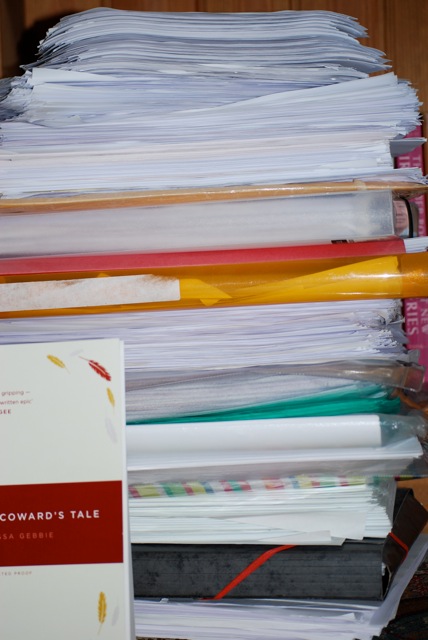
This pic? The stages of revision of the whole manuscript, AFTER the first draft of the novel was completed. Starting in March 2010, finishing in Oct 2010 -re-creation of one character, then plot tweaks, and the all-important structural revision, where I needed to see the whole thing in one spyglass, over and over and over. Then the revisions became smaller, then tinier, a word here a word there...read through for sound - working towards a cleaner and cleaner product. Because that's what it became. Emotion left the room, and only the words mattered. Getting them right. The top few layers are Bloomsbury-led, tweaks and copyediting proofs. The final layer is the uncorrected proof pages recieved last week- and the uncorrected proof book itself, all ready to go out! Very exciting.
It's a salutary thing though. My manuscript was c 250 pages in length. It didn't vary much. The finished book is 380 pages - 130 pages longer - maybe due to different typeface, less lines to a page... ! Even though I feel horror at my use of precious paper in revising here -I don't know how else I might have done it - and I console myself that the pile could have been a lot higher.

Sunday, 24 April 2011

SAYING TA...


I blog about putting together the acknowledgements page for The Coward's Tale, over on the other blog.


Lovely thank you pic from here

Thursday, 21 April 2011

INTERVIEWED BY TIM LOVE


I met Tim Love, who I have 'known' for a few years as a colleague online, last week - he forewent a few days with his family at Centre Parcs to come and listen to Andre Mangeot and me reading and nattering at Cambridge Word Fest last Saturday. And I am delighted to be the subject of a rather good interview on his blog, HERE What do we natter about? Could I have done this writing stuff faster? What about teaching - does it hep or hinder? The pros and cons of writing groups. Triffic stuff.
Thank you Tim, very much,

Tuesday, 19 April 2011

SHORT STORIES - HOW, WHY, and ARE THEY A GOOD TRAINING GROUND FOR NOVELISTS?

We’re coming towards the end of a fascinating and rewarding series of discussions on the short story, hosted by Professor Patty McNair of Columbia College Chicago. Who is ‘we?’ – Patty McNair herself, of course, together with Gerard Woodward, recently short-listed for the Sunday Times short story award, Gina Frangello, Dennis McFadden, and me. We discussed the 'why' of the short story, and the 'how', and whether short fiction was a good training ground for the novel, as many CW theorists seem to suggest.

Here is a series of links to the articles - all absolutely fascinating, from practising, well published short story writers, some of whom do a lot of teaching of this thing called writing.

HOW THE SHORT STORY?? “Do you decide to write a short story, or does a story decide to be written?”
Prof Patty McNair herself said,
“HOW the short story? WRITE the short story. Then REWRITE the short story. And WRITE it again. James Thurber said, “Don’t get it right, just get it written.” I’ll second that and raise him: “Don’t get it right, just get it written, and THEN get it right.” That’s HOW.”
ARTICLE HERE

Gerard Woodward
“Memory and extended memory offer a bewilderingly, near infinitely vast amount of potential subject matter. There can never be any excuse for not having anything to write about – writers’ block is just a kind of narcolepsy brought on by an inability to deal with the vastness of one’s extended memory, either through fatigue, lethargy or depression.”
ARTICLE HERE

Dennis McFadden
“Does writing a “successful” story have anything at all to do with creativity? I think not. Creativity does, however, have everything to do with how the short story... When we wonder does the author decide to write the story or does the story decide to be written, is the story willed into existence or is it a matter of spontaneous combustion, doesn’t the answer depend upon just how creative that particular author is?”
ARTICLE HERE

Gina Frangello
“short fiction is a trickier paradox. The writing is even more “channeled” through the writer—even more intuitive, obsessive and raw because it remains fresh, is not stretched out over years but rather over a few days or weeks—and yet because of the length the writer is permitted fewer digressions, fewer missteps, wherein every word must be crucial and resonant. This would seem hard to swing when the story is writing you! But perhaps the reverse is true. All work—novels or stories—will be revised and edited by the writer once the first draft is complete, and I’ve often found that the stories that simply pour out in one or two sittings require surprisingly less editing than those that I really pondered meticulously over a long stretch of time.”
ARTICLE HERE

Self
“I write in a state of ‘knowingness’ – ‘awareness’ – but I do not plot. When I get towards the end of the first draft, I can ‘see’ the ending, with little detail.”
ARTICLE HERE


WHY THE SHORT STORY?

Patty McNair "In the early 1980s, I found this little book: What We Talk About When We Talk About Love. I know you know it. Raymond Carver. And regardless what you think about Carver or that literary generation’s minimalism or Gordon Lish or any of these things, I am not afraid to admit that these stories opened up a world to me. They were manageable (some no longer than those tiny stories in my SRA books long ago) and moving. They were brutal and they were fearless. I didn’t know that stories could do that. I didn’t know you could tell these things, say them out loud."
ARTICLE HERE

Gerard Woodward
“I began to see that one couldn’t approach the short story with the same imaginative gear of a poet or novelist, you had to have the unique, special, short story head. Without this apparatus you were unable to see either the potential for short stories in the world around you, or to write them.”
ARTICLE HERE

Dennis McFadden
“In the end, it probably comes down to goosebumps....On the other hand, much as I enjoy novels, I don’t recall a single goosebump ever caused by one...”
ARTICLE HERE

Gina Frangello
“The short story is an incredibly diverse form. It combines the best of various other literary art forms.”
ARTICLE HERE

Self
“Who needs mind-altering substances when you have stories? Do novels do that quite so well? Mostly, no. because the author is doing the filling of the world for you, to a large extent. They are making you live the dream they had themselves. Whereas with a good, well-written story – it plants seeds. They grow inside you.”
ARTICLE HERE


IS THE SHORT STORY A TRAINING GROUND FOR THE NOVEL?

Patty McNair "I hate this idea. I hate the idea of making a whole class out of little, tiny stories. Of teaching students to write short. (As though people who text and tweet and blog and shorthand through most forms of communication need us to encourage them to keep it short!)
Okay, don’t get me wrong. I love the perfect short-short. Adore it. Think “Bucket Rider,” by Franz Kafka; “The Porcelain Doll,” by Leo Tolstoy; “The Story of an Hour,” Kate Chopin; “Hills Like White Elephants,” Ernest Hemingway; “Girl,” Jamaica Kincaid. These are stories I turn to often, stories I learn from and I use in teaching. I have my own short-short stories, too, in The Temple of Air. “The Joke.” “Deer Story.” “Hand Thing.” But you know what? I had to write hundreds of pages in order to write these two and three page stories. I had to write long long long in order to really do the short-short thing." ARTICLE HERE

Gerard Woodward
“I think it is a big mistake to think of the short story as a practice ground for the novel, a stepping stone towards the longer form. This is because the two forms tend to work along opposite lines of force to achieve their effects. The novel is all about filling big narrative spaces, while the short story is all about suggesting those spaces and using the restrictions of space and time to powerful effect.”
ARTICLE HERE

Dennis McFadden
“Unquestionably. Undeniably. Until the cows come home. Bear in mind, however: the novel is every bit as much a training ground for the short story."
ARTICLE HERE

Gina Frangello "...While much can be made and dissected of the difference between the story and the novel, the real difference here—the essential difference—has to do with what a writer wants out of his or her career vs. what the market wants. The short story can be mere “training ground” for the novel if the writer sees it that way. However, such writers should keep in mind that writing a novel is no neat guarantee of selling a book for good money at a big New York house either. Deciding to write “to the market” is a risky endeavor..." ARTICLE HERE

Self
“I wonder if a successful writer of short fiction may find it hard to write a novel, because they need to unlearn so much. However, when they finally do, I wonder if they might write a better novel than they would if they were not short story writers first.”
ARTICLE HERE

.

Saturday, 16 April 2011

CAMBRIDGE WORD FEST


Today was green rooms, and seeing fleeting glimpses of faces that looked rather familiar and important - but might just have been passing traffic wardens. Today was meeting poet and short story writer Andre Mangeot with whom I was sharing an event at the Word Fest, and enjoying nattering very much both during the event, and after over lunch in the garden. Although our work is very different, we seem to be exploring similar themes. There was a good audience, lots of faces, lots of listening and lots of questions. Andre read extracts from two stories in his second book of fiction, 'True North' - a marvellous collection in which the reader is transported to many different countries as Andre explores themes of betrayal and identity and the fragility of dreams. I read 'Letters from Kilburn' from 'Storm Warning' - it seemed to go down well.

Today was saying hello in person to the 'crabbit old bat' Nicola Morgan, whose blog Help! I Need a Publisher is a must for all aspiring and not-so-aspiring writers..., and finding out that she didn't seem crabbit at all - her event preceded ours, in the Cambridge Union Dining Room - a nice sized room, with atmosphere aplenty. And today was meeting up with writer, poet and IT guru Tim Love whose Litrefs blogs and archives are a goldmine of info on all aspects of the written word as far as I can see, who came to the event and with whom I spent a happy hour on a guided tour of Cambridge after lunch. Thanks Tim! And he's already blogged about the event - see link back there!
Today was also having a guided tour of Audley End House on the way back. Altogether a good day.

Wednesday, 13 April 2011

BOOK REVIEW - New Short Stories 5


BRIEF REVIEW
New Short Stories 5 – the twelve finalists from Willesden Herald 2011.

This is a strong collection, and for anyone who wants to see what sort of stories make it to the final cut in a really worthwhile short story competition (as opposed to the other sort...) it is a necessary purchase, I’d have thought. But even if you are just in it for the read, there is something here for everyone.
This year’s final judge was Maggie Gee – she says this of the pieces she chose:
“Every human type and taste is here – sad, funny, fresh, sharp, gripping, sour and sweet – delicious small mysteries ...”

This year’s winning story, ‘Out of Season’ by Irish writer Mary O’Shea, is simply the best short story I have read in a long time. It is difficult to think of another story with such delicate tracery, exploring quite so unflinchingly a difficult subject that is mauled so often by lesser writers. That tracery may be delicate, but it is iron-wrought and beautiful in the real sense of the word. This story is at the same time poignant - achingly so, but with not one scrap of sugar or sentimentality - and absolutely uplifting. This is what short fiction is about. This is by a master of the form.

‘Apartment’ by Y J Zhu is one of two equally placed runners-up. Zhu, ‘a native of Beijing China, who now lives in San Francisco’ gives us a closely observed tale of time passing, time past, and asks the question ‘where, and what, and above all with whom, is ‘home’?’ The other is ‘Homecoming’ by Alex Barr, who now lives in west Wales. Interestingly, this is another story about belonging, or not – and asks similar questions to Zhu’s story, although the setting, Manchester, is more familiar.

The nine other stories are worthy finalists, and a strong field created by some real rising stars. In no particular order then - There is the hugely poignant ‘Gusul’ (a washing ritual, for the dead), by the Swedish-based Bosnian writer Adnan Mahmutovic - a story I know well, and find more moving each time I meet it. There is the spare and enigmatic writing of Teresa Stenson - whose previous successes include a Bridport prize - in the marvellous ‘Blue Raincoat’, the shortest story here at less than four sides, and one of the most intriguing. There is A J Ashworth’s extraordinary, exciting and memorable ‘Overnight Miracles’, a psychological drama/sci-fi mix about a woman desperate to recover what is lost. There is the harrowing but beautiful ‘The Bedroom’ by Michael Coleman, who seems to have packed a novel’s worth of experience and emotion into a few pages. And David Frankel’s ‘The Place’ with its marvellous voice and vulnerable main character, keeps on intriguing long after it is read. There is another vulnerable character in Emma Martin’s ‘Victor’ – making this reader wonder if strong beliefs make people easy targets. All these stories are thought provoking – raising questions, asking the careful reader to look again at what seems ordinary. Adrian Sells has a look at the onset of Alzheimer’s in the closely observed and sensitively written ‘Thingummy Wotsit’, and Angela Sherlock’s ‘Set Dance’ is gentle, very well observed, well voiced, and very funny, as it follows two middle-aged Irish farmer brothers to the fair, in search of women. Lastly, and not least, and at almost thirty pages, by far the longest piece of work here: ‘Dancing with the Flag Man’ by Nemone Thornes – a dark coming-of-age piece.
There is indeed something for everyone – this is a very good collection, putting many anthologies in the shade. Highly recommended.

Tuesday, 12 April 2011

CONSIDERING THE SEASONS


On the trail of cyclical events, I stumble over the four seasons. It is hard not to, especially living where I do - the seasons are defined, each has its own characteristic colours, sounds and smells.
Some people like the definite seasons – summer or winter. When you know where you are, unless nature plays its ever-increasing tricks on you. Summer is usually warm. Ish. Winter isn’t. And some, like me, prefer the in between seasons, spring and autumn. When things are more fluid, the edges are blurred, when temperatures are not so predictable but there can be pleasant surprises. And conversely...
But this is not a diatribe on the seasons, weather-wise. Not really. It is to do with cycles of creativity.
Perhaps each of our creations goes through its own cycle. Perhaps it begins in winter when there is little or no growth, when you can see nothing moving, and all seems dead. And, like winter, perhaps there is something stirring beneath the surface...
Maybe whatever it is pushes through finally in its own springtime. When it is strong enough to be considered, looked at. When it is new and fresh, and brave, and won’t leave us alone, even if we wanted it to.
Perhaps in its summer, it grows fast. Maybe its colours and scents deepen and become richer. Now is the time we know what we are doing, where it really has taken off, and follows its own paths. Maybe in the heat of its creation it grows untidily and will need pruning.
And it is in the autumn, when it is ready – after trimming, and shaping, when the fruit is ripe and ready to harvest.

And when it is, oh doesn’t the creator feel empty, and tired? And doesn’t each creation take its own time, and grow to its own rhythms?

Monday, 11 April 2011

The COWARD'S JACKET


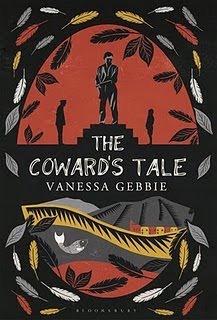
This is the final jacket for 'The Coward's Tale', thank to the genius and patience of Holly MacDonald, Assistant Art Director at Bloomsbury.
if you compare it with the version on the right, play spot the changes! The characters of the little boy (Laddy Merridew) and the old chap on the left (Ianto Passchendaele Jenkins) have been tweaked several times, until they felt right.

Friday, 8 April 2011

WILLESDEN HERALD PRIZE RESULTS


New Short Stories 5 - the 12 finalists immortalised in print - 'Every human type and taste is here - sad, funny, fresh, sharp, gripping, sour and sweet - delicious small mysteries that suddenly reveal their secret hearts.'

Smashing event, as always, held this year at Willesden Library Centre - and even more special this year because Maggie Gee (she of the rather lovely quotes on books...) was the Willesden Herald Short Story Competition final judge. And even more special again because the line-up is truly international - look -
1st Prize:
"Out of Season" by Mary O'Shea (Ireland)

Equal runners up:
"Apartment" by Y. J. Zhu (USA/China)
"Homecoming" by Alex Barr (Wales)

For the complete list of finalists, all of whom have their work in this year's anthology - please see The Willesden Herald itself HERE-
And, if I may- it was even more special again, because Liar's League and WHSSP had teamed up. Six of the finalists had excerpts of their work read/performed.

I was there pretending to be my friend and colleague Adnan Mahmutovic, whose very moving story 'Gusul' (washing) was a finalist - but he was teaching in Stockholm, so sadly couldn't be there. Smashing to see lots of writer-type friends there, and to meet some new faces (facebook faces!) especially the uber-talented A J Ashworth, whose story excerpt, dramatised by Sarah Le Fevre, kept the room totally silent and spellbound. And even though I know Adnan's 'Gusul' well, I found the excerpt, (dramatised by Elizabeth Bower) incredibly moving.
All three of the winning stories had excerpts dramatised. So when the decisions were announced in true MG style, giving careful generous validation to each and every writer - we felt as though we knew them already - and worthy winners they are too.
Off to the pub afterwards... 'Oh alright, just the one G and T then...' and lots of natter, networking, and absorbing talk to Nick Rankin (Mr Maggie Gee) about his latest book - on the Royal Marine Commandos, due out from Faber in October. And the one before that, Churchill's Wizards, about subterfuge and camouflage in conflict... perfect. Amazon had a bashing this morning.

Thanks to all the Willesden crew, smashing event. And thanks to Lane for a rather lovely B and B experience.

Tuesday, 5 April 2011

FOLLOWING IN THE FOOTSTEPS OF THE SWANSEA PALS

We picked up the trail of the Swansea Pals Battalion (14th Battalion, Welch Regiment) in the tiny village of Septenville - little more than three or four farms on a side road - where they were billeted on 1st July 1916. As we approached the village a male hen harrier rose from the furrows on our right, disturbed by the sound of the car. The old brick barns sat exactly as they were almost a century ago - it did not take much of a leap of the imagination to see the bricks a brighter red, the pointing clearer, and to see the battalion - the officers settling down to supper in the farmhouse, and other ranks eating supper in the farmyard- washing under the pump, arguing over the best corners in the barn. Taking the chance to write a letter home.
I spent five days in the excellent company of military historian Jeremy Banning, following the progress of the Swansea Pals Battalion through the battlefields of WWI. I wanted to literally go where they went, stand where they stood, see the roads they marched along to the front, see where they fell. From Septenville to Rubembre. From Rubembre to Herissart...Franvillers on 3rd, Heilly... Heilly was the site of a large casualty clearing station, the wounded brought from the front by train, ambulance.... And up the rise is Heilly Station cemetery. Men were dying too fast for the gravediggers to keep up. Many graves are home to three bodies. I couldn't help wondering if the Pals saw, heard, smelled the chaos.
       There was no rest for the Pals at Heilly. Orders came that the 38th Div would relieve the 7th, and on they went to Fricourt. The Citadel. 5th July, 6th July. On the 7th July they were in the support trenches here, the final training - and suffered the loss of four officers, accidentally wounded whilst practising the throwing of percussion bombs. I wonder if they also knew that those in charge higher up had been sent home, following the failure of the first wave of attacks here?
Their objective, and ours, was this irregular patch of woodland, this nearest section called the Hammerhead, and the stretch running away to the left. It was attacked by the Welsh over 7th to 12th July 1916 - but the attacks before the Pals got there had not been a success.
       Jeremy and I stood on the ridge at Danzig Alley Cemetery, looking down on the village of Mametz, and the wood that bears the same name, over to our right in the gloaming. It was cold. The Swansea lads moved up to the front line, White Trench, on 8th July 1916. The attack was planned for the following day, as we ourselves would visit tomorrow. In the end, the attack was delayed by twenty four hours, and I can imagine the tension, as those who chanced a glimpse of the terrain looked across open ground to where it slipped away in a thirty foot 'cliff', down to the open wide space (now a series of open fields) they would have to cross to the trees, where the enemy was waiting.
       This is from Wikipedia - inaccurate I think, plus ca change - I believe the fighting concentrated actually in the wood itself, but you get the idea:
The 10 July attack was on a larger scale than had been attempted earlier. Despite heavy casualties the fringe of the wood was soon reached and some bayonet fighting took place before the wood was entered and a number of German machine guns silenced. Fighting in the wood was fierce with the Germans giving ground stubbornly.
The 14th Welsh (Swansea) Battalion went into the attack with 676 men and after a day of hard fighting had lost almost 400 men killed or wounded before being relieved
.
Mametz Wood by Christopher Williams*


Today, the wood is privately owned, and there are man-traps deployed as it is used for hunting. We weren't meant to be there, and I was apprehensive - appropriately. We slipped and half-fell down the 30 ft 'cliff' from White Trench to the field, and after a few moments consolidation, walked fast straight ahead, taking care not to step on the crop. Reaching the edge of the wood, we did not go too far in.
      There are many hundreds of bodies still in Mametz Wood, in two mass graves, according to those who know. Their names are on the Thiepval Memorial to the Missing.
       This is from an account from Pte Sweeney, 1st Lincolnshire Regt.
"In Mametz Wood there are not hundreds of dead, but I should say thousands as it is very big. When we started attacking this wood the trees were so close as they possibly could be but you should see it now, you can see straight through it quite clearly."

Mametz Wood today. The firing pits and rough trenches can still be seen.
Over the five days, we stood in many cemeteries now tended by the Commonwealth War Graves Commission, marvelling at their beauty, their peace. The endless stories, if you listen to the breeze in the willows, the names, dates, inscriptions. The brilliant white of endless headstones against the green of the turf - the flowers from our little islands. Aubretia, tulips, Christmas Roses, Daffodils. But no cemetery was as beautiful as Mametz Wood with its wood anemones and early bluebells. And, where German machine-gunners and snipers had hung from their ropes high in the trees, where the Pals got caught in a bombardment by our own artillery, and where there was carnage - the low mist lifted to show a sky reaching almost to the ground, glimpsed between new trees where the wood was narrowest, several generations on from their splintered ancestors, growing up from a carpet of stars.

One of the bodies never found is that of the young runner, Watcyn Griffith, Private 26402 17th Bn., Royal Welsh Fusiliers. He was the younger brother of Wyn Griffith who wrote ' Up To Mametz Wood'. We went to find his name, at Thiepval. And we did. But he's there in the wood somewhere, with many of my Swansea Pals, who over the five days of my visit, I came to think of as 'my boys'. Is that daft? I doubt it. Most of them were younger than my own sons -and it felt good to be with them for a while.

.
.
*Mametz Wood by Christopher Williams is the property of Swansea University.