Saturday, 22 September 2012

Retreats For You


I loved the blue walls in the yard
As everyone knows by now, I can’t write much serious stuff at home, and take myself off to far-flung places to find the muse. Thanks to a rather large birthday, I was able to spend five nights at Retreats for You last week, in deepest darkest Devon. Actually, it wasn’t... the sun shone most days, the village of Sheepwash is beautiful, and the 18th century cob and thatch house is quirky and rather wonderful.
Sheepwash square - Retreats for You is on the right.

Owned and run by Deborah Dooley and her joiner husband Bob Cooper, Retreats for You is a heartwarming experience from welcome to goodbye. Deborah (or Deb, never ever Debbie...) was waiting for me when I pottered at five miles an hour up the lane into the vilage, and she came out to say hello, help with bags, and ask where my clothes were... I’d only got one small bag of clothes, was wearing the rest, the other three bags were books, and novels, and papers, and writery stuff. Not used to taking anything but a very few sloppy comfy clothes when I whizz off to my usual writing retreat in Ireland, I was momentarily thrown - did Retreats for You writers dress for dinner? Oo-er.
       I am rather happy to report that they definitely don’t. I had smashing company - one writer was working on a final polish of a rather terrific fantasy novel, another, about to burst on the world when her first (and deliciously controversial) book comes out in early 2013, and who until then is wearing a large bag over her head, started a hilarious YA novel that had us in stitches, and a third was in the early stages of a very poised series of novels with just a touch of the surreal...

My room, overlooking the square
The house is great - it has been through many different guises in its time, and has settled rather nicely into a comfortable, somewhat rambling although not over-large family house that lends itself well to opening its doors to writer-types and others.  Tip: I'd check that all the guests are writers or other artists of some sort - Deb and Bob occasionally accept B and B guests, although this is rare.

       There are four study-bedrooms, a mix of comfy doubles, twins and singles. There is crisp white linen, an endless supply of white fluffy towels, and white bath robes and slippers are waiting in every room. Deb and Bob have worked hard to make the rooms bright and fresh  - painted floorboards, hand made wooden shutters on every window, white cob walls. The rooms at the front of the house, overlooking the square have slightly larger windows if natural light is your thing. The rooms at the side are atmospheric spaces, in the older part of the house, I’d guess, with thick walls, and windows pushing up into the thatch. The bathroom upstairs is awash with handcreams, bodycreams, body scrubs, shower gels, shampoos - it is hard to get out of there - I had to try everything, naturally.  There is another shower room and loo downstairs. There is also a visiting massage therapist and beauty therapist.
The poet's bench
The village of Sheepwash is on a hill surrounded by rivers and low-lying ground... apparently the name originally meant ‘surrounded by water’. Which is odd because that's also what Ringmer means, (where I live). There is a glorious walk by the river, a Pre-Raphaelite dream of a place, so much so I expected Ophelia to float past.
       Deb is an amazing power-house of organisation and support for her writers, unwilling to let you do anything except relax and write. Breakfast can be any time from 8 to 9.30 - after that it will just be toast -but for those who do make it down in time, bacon eggs, tomatoes, mushrooms appear from the kitchen with great regularity. She will have been up well before you, and will have gone for a run, and be wearing a natty pinny over her jeans. You are not allowed to clear tables. Lunch was outside on a couple of occasions, in the yard, where we feasted on salads, home made bread, cheeses, soups, salads, fruit. Suppers were great too, candles on the tables, a chance to catch up on the day and natter with Deb and Bob before going to the sitting room to lounge in front of the fire on squashy sofas. Readings, or natter, or telly - Downton Abbey ruled one evening, and Great British Bake-Off the next. She works incredibly, but incredibly hard. And if you check out her website, has been a journalist for years - and that is something that still takes up time. Amazing woman.

Bob and iroko wood, salvaged from St Joseph's Convent chemistry lab, in Reigate. 
The other half of the Retreats for You partnership is Bob the joiner, who once worked at Windsor Castle.  He also makes excellent cups of tea. The website said that he offered carpentry workshops in his workshop, so I asked, and lo- spent a glorious morning under his tuition transforming a piece of wood into a useful something. I think it is a cheeseboard, or a breadboard. 
Bob's workshop - with St Joseph keeping watch, top right...

It even has my name on it. 
So, did I write much? No - I spent the first couple of days catching up on Lyn MacDonald’s book ‘Somme’. Then I spent the next two rejigging and revising and generally bothering the first 20 pages of the next novel. The voice is off. And  of course, making a cheesboard. This was a retreat in all senses - relaxing, and rather blissful. And the cherry on the cake was hearing, just before I left,  that I was one of the winners of the 2013 Gladsone's Library residency. I left feeling absolutely wonderful, ready for anything. 

Retreats for You costs £68 per night, slightly less if you go for seven or more days. A workshop with Bob costs £40. I reckon it is excellent value, and would recommend it highly - I have long been in touch with other writers who go here, and love it - now I know why.

PS - Do not call Deb Debbie. She does not like it.  No - she hates it. For me, that was a bit like telling Basil Fawlty not to mention the war...


Wednesday, 19 September 2012

Online Writing - an Arvon course with Sarah Salway and co

Sarah Salway
So - a week or so back, I read about a really interesting new course being offered by the  wonderful Arvon Foundation - Called Online Writing, there are three great tutors, including writing friend Sarah Salway. I was intrigued, and asked Sarah to answer a few questions about the course, and the rather special venue. So here you go!


Vanessa: Arvon Foundation courses are just the best... for someone who has never heard of Arvon - what is it?  

Sarah: The perfect week really! You get to spend time in a beautiful setting with other writers, at every level, deepening your craft and skills, and expanding your knowledge and imagination. There are two tutors and one guest reader for the week, and mornings are normally spent doing workshops, afternoons writing or having one-to-one tutorials with the tutors, and evenings are spent sharing what you've written or hearing other people read to you. Also there are trips out to the pub! 

V: Of course (no pun intended) you get what you pay for, but it is quite expensive - however, I believe Arvon give financial help where applicable ? How does someone find out about that?

S: If you look at the Arvon Foundation website -  there are details on how to apply for financial aid for courses. I haven't done it myself, but everybody I've met at Arvon is very approachable, so I hope that nobody would be put off applying.

V: Online Writing course - that sounds interesting - but what exactly does it mean? What will you be doing?

S: Between us, we have designed a course we'd love to go on ourselves! While on the one hand it's supremely practical - both Jon and Danuta are industry experts - so it's looking at what is happening for writers on the internet now. On the other, like all Arvon courses, it is all about the writing. Hopefully, writers will leave with a deeper understanding of how to write for different readerships and in different styles, which has to make all aspects of their writing more powerful. It's also personal - we will be looking at the best way to promote your work, your ideas and indeed yourself to who matters to YOU! I know from my own experience that writing for blogs, even in short bursts on twitter, has improved my creative writing and opened up new possibilities for me. We will be looking at communicating our messages - from photographs, to opinion pieces, to different ways to share creative writing, and also guest posts. 


V: Why is there a need for this course?

S: It's clear - and Danuta is one of the best placed people to talk about this - that to be published nowadays (at whatever level) some kind of web presence is helpful. I must admit I embraced blogs etc very early on - starting my own in 2003, but I keep meeting writers who hate the very idea. It feels to them a distraction, or even a personal intrusion. I think the course will be good in exploring how you can talk personally but not about yourself (if that makes sense). But also many people don't know where to begin, or have been writing blogs etc for some time and aren't getting the audience they want. There's no magic wand, but we will be looking at really good ways to target your energies. 

V: Who are your co-tutors?

S: Jon Reed is an author and social media expert, who runs Publishing Talk  . He is in very wide demand for coaching, presentations etc, so all the writers having a one-to-one tutorial with him will be lucky. I'm planning on asking for one myself! Danuta Kean  is one of our top publishing commentators and she's going to give an oversight into what is happening in publishing now, and how each one of us can improve our chances of getting noticed. Most importantly though, both are lovely - it's going to be a fun course!

V: What experience does a would-be participant need to have?

S: There will be help in setting up a blog, so really someone could come along with no experience at all. Equally, we know that there are people interested who have been running a website for some time but want to add some more sparks to it. The whole idea - as with all Arvon courses - is that while you look at your own process and what works for you, everybody will learn from everybody else. Even people who hate the very idea of the internet will find something to take away with them!

V: It's at Lumb Bank - I've never been there - tell me what it's like?
Lumb Bank,  by Abi Morley

S: I haven't been there either, so I'm really excited. But just look at this photograph....beautiful, eh? (V, attached. It's taken by Abi Morley and I'll get her permission!)

V: The Arvon courses I've been on have  been hugely life-affirming, and life changing too. What three things do you most hope this course will give to the participants?

S: Oooh good question...
1. The feeling not only that they CAN do it, but that they are excited about writing online and feel confident that they know what they want to say, and to who.
2. A notebook bulging with creative ideas they might not have thought of before. And a desire to keep exploring after the week is over too.
3. New friends.
I'm hoping for all of these three things myself! 
What I would say is that if anyone is interested and wants to know more, they can email me direct - sarahsalway@gmail.com - and I'll do my best to answer any personal questions.

Brilliant... thank you Sarah - so there you go - a wealth of info on what sounds like a rather interesting course. Speaking as someone with a moribumd website - I wish I could go myself!

Tuesday, 4 September 2012

John O'Leary

John at Anam Cara. 

A short while ago, I heard of the death of poet, farmer and scholar John O'Leary, in very tragic circumstances.  I met John first some years back, at my lovely writing retreat in West Cork, when he popped in for a meeting with Sue, the owner.  We met many times over the years. He looked wild as anything,  littered his speech with Latin quotations,  knew the history, social history, the mythology, the geography, geology, the flora and fauna, and a lot more, of this part of Ireland. A man who wrote poetry - didn't bother too much about publishing it - but was proud of his two books, each collections of 77 fractured sonnets - 'Sea' and 'Salt', from a tiny now-defunct press in Seattle.  Who could recite you so many things  - he had an extraordinary memory. Who taught both locally and abroad, who had a First from Trinity Cambridge and another degree from Trinity Dublin. 

John getting ready to read his poems to my short story writers, at Anam Cara in June this year.

Born in Boston, US, he had lived most of his life in West Cork, on a small farm in the tiny village of Allihies, where he bred Irish Draught Horses, farmed sheep. His farm overlooked the North Atlantic. His study, a treasure-house (some might call it a shambles!) of books and papers, had a spidery window looking down over fields to the strand. 
He used to inspire the kids at local schools. The book in the first photo above is a hand made book he helped the older students to make, at the local school. They made the paper from nettles. The ink. The covers from wood. The binding twine also from nettles. They used gannet feathers found on the strand for quills and each student wrote what they wanted to be in life.  He'd also been Visiting Professor of Creative Writing and Irish Studies at Illinois Wesleyan University and Seattle University and has taught at numerous universities in America and Europe. And he ran workshops at the Anam Cara Writers' and Artists' Retreat - with Paddy O'Connor - another friend, a retired headmaster. I was due to go and enjoy a week of their inspirational teaching and insights next year. 
Sadly, John drowned in the sea not far from Allihies, after his fishing boat capsized.

So - as a goodbye to an irreplaceable genius, here's the account of a wonderful journey John took me on last year - into the old copper mine above Allihies. 'I know a way in', he said. 'We used to go when I was a kid.' Paddy O'Connor wanted to come too. 


John at the entrance of the tunnel


So we drove up there, and we parked, John Paddy and I, by the side of the stony road that leads to the Mountain Mine. Barbed wire fences didn't worry John. Off with the jacket,  laying it on the barbs, he swung a long skinny leg over the wire. Me, I don't have those legs, and Paddy said, 'We'll go this way, and we scrambled up the steep slope, slid down rocks, up again, managed to negotiate some easier fences, and eventually dropped back down the slope to where John was standing at the entrance to a closed-off tunnel. 'Oh, its got a lock,' he said. And, 'Oh look, someone's broken it...' Hmm...


Down the tunnel, lichen-covered and dank, up to our ankles in water
I'd borrowed some beach shoes, which was a good thing - 'Be ready for water up to your knees...' John said, pushing the metal gate aside, grinning, and disappearing into a black-as-night tunnel. I took a photo with my phone - it showed for a second the green growths on the walls, the rock-strewn floor, the water. And John's back, rolled up jeans and ubiquitous tweed jacket, disappearing....
Looking up, the sun shone down the spent vein, blueing the walls

Feeling for rocks with our feet, scrambling over a low wall or two built to keep us out, no doubt, we ended up in a wide cavern. The walls ran with damp in places, catching the light. Light which filtered down from above, a slash in the ground, perhaps where a seam has been exhausted many years before the mine was closed. And as my eyes became accustomed, I could see places where the walls were blue, turquoise, green, cobalt - the sunlight catching the colours and throwing them about. There were the wooden supports for walkways long gone. Places where ladders would have taken the miners from one level to the next. There were metal hooks in the rock, gaping, somehow, waiting.

Looking down, the wooden walkway supports from a century ago


Kneeling in a shaft of light to read a poem by a  Cornish tin miner


The floor of the cavern ended suddenly, and the ground fell away into the mineshaft. Not, as I had imagined, a rough circular hole - but a slash the whole width of the cavern, and about six feet across. Thanks to the light from above,  you could see the shaft, disappearing downwards.  Then nothing. You could see the walls, with their blue and green artwork. Then nothing. In the picture above, John is kneeling right on the edge of the shaft - the flash from my phone-camera has lit up the wall going down.   He took a paper from his pocket, and proceeded to read - perhaps the most extraordinary and memorable reading/listening experience I will ever have. John read out loud, his words echoing slightly against the walls. He read a poem written over a hundred years ago, by a Cornish tin miner, describing riding to work on the man engine at Levant - the lift device  that had inspired so much of the structure of The Coward's Tale - but which I had taken out of the novel as one of the last sacrifices during editing.  

The shaft is black and deep, bright blue stains in the rock
There was a man engine at this mine too, and its building is still to be seen, high on the mountain above Allihies. Hearing the words here, in this place, where they seemed to fit so well... I can't describe it. We stayed for a while, drinking in the atmosphere. Talking in hushed tones when we talked at all.  Most of the time I think all three of us were overwhelmed by the place.  I didn't want to leave - the place was magical - a sense of history, and strife, it is no doubt full of ghosts. But the ghosts let us be. 
back through the tunnel towards daylight
And in contrast to our journey into the mine, the tunnel on the way back seemed very different. Instead of the night that lay ahead on our way in, we journeyed out, towards the brightest light.

Thanks, John.


.


Thursday, 30 August 2012

A visit from Meg Pokrass

Meg
So, a while back, a facebook friend, the writer Meg Pokrass, invited me to be a visiting editor on Fictionaut, the online writers' hub and forum she helped to create. I had a very enjoyable week or so, reading all the poems and stories that were uploaded - with a brief to pick the ones that struck me as fascinating/good/well done as opposed to those which had the most likes and comments from the members... an interesting ask, yes? And very important, I felt, to acknowledge that bias that creeps into writing group behaviour and try to do something about it. I liked that.
Meg is a prolific writer. She sent me her amazing collection of flashes, 'Damn Sure Right', and I have loved the ride through an extraordinary 80 pieces of work, the vast majority of which have been published in excellent journals. She is also a novelist, a poet, a playwright. And now she is an interviewee here. But before all that, here is a taste of her work, with her permission.


She Wanted a Dog
 Her daughter was shy and reclusive. Her husband had wanted a son. Her family seemed downtrodden and anxious. They were a small family of three—fastidious. She thought about the idea of bringing home something furry with hot breath that didn’t come with an elaborate set of instructions and warranty options. She pictured her husband and her daughter at the beach with it, throwing it a Frisbee. The agile dog catching it in his mouth and running, running, running. Her family battling their brittle nature, chasing each other on the sand. The three of them laughing over the brown paw prints on the beige rug after a walk with the dog. They could care less, they would love that dog so much. She could see it in her mind and even smell the dog on her hands. She also knew she was lying to herself. She remembered how it had been hard on their relationship when she had rescued a parakeet during their courtship. He hated knowing the miserable bird was captive in their one room apartment, watching. Fucking became strange and self-conscious. As predicted, the bird became quiet and lost most of its feathers. Finally, she gave it to a cab driver out of desperation. They didn’t break up, but they never spoke of it again. 


VG: Love it! And I love the quote about your work from Frederick Barthelme  “Meg Pokrass writes like a brain looking for a body. Wonderful, dark, unforgiving.” ! So - tell me a little about you, and where writing fits into your life.

  • I have worked at home for the last 20 years doing corporate consulting. Writing has always been something I’ve had in my life. I have worked privately with a few writing mentors… however, I was often blocked. The worst block was during an extended illness. When I recovered, and my energy returned (about 5 yrs ago now) I discovered flash fiction was growing in venues through online publications, such as Smokelong, elimae, Flashquake, Storyglossia, and Hobart. I decided to try my hand at little stories which my poems had always felt similar to. Blocks and inhibitions went away when I found my voice in flash. Ecstatically, I wrote a ton, submitting to magazines in quantity and I suppose, rather fearlessly. In my then community of poets, eyebrows lifted. My pieces began to be published and a few poets in my poetry group were appalled that I was writing flash and publishing on line. It felt like becoming a stripper! Feeling their disapproval made me even more determined to succeed at publishing my work.
VG: Wow. isn't it funny, how others sometimes try to undermine what we do? Luckily they are few and far between. How does writing fit into your life now?


  • Writing defines my life. I’m terribly glued to it. Currently I am co-writing a screenplay which was commissioned from my novella “The Sticky Lust of Hummingbirds.” with screenwriter Graham Gordy. I am writing a lot these days, fueled and inspired by working with a writer I admire more than any other. I am the most fulfilled, creatively, that I have ever been. I spend days reading, editing, interviewing, writing, doing animal chores, driving my kid Molly (15 yrs old) to where she needs to go, maintaining a home with 6 animals and 3 humans living inside it.
VG: Tell me about writing this collection? How long did it take you? How did you decide which pieces to include and which to leave out?

  • Writing the collection took around a year-and-a-half.  Choosing was simple: I put in my favorite pieces, 90% of which had been published.
VG: Damn Sure Right is, as the title suggests, a collection of raw, strong
writing, flashes in which characters and their lives are conjured in a few
sentences, with many finely wrought layers of emotion, and conflict. Sexual
experience features large, especially early sexual experience.


  • “He didn’t need to hurt her, damn sure right,” are words a good Samaritan (in the title story) says to the cops. The good Samaritan is an African American woman who had been hiding to protect herself while witnessing a mugging. When safe she comes out to help pick up the pieces. This utterance meant many different things to me as someone who had been mugged (that is the only truly autobiographical story in the collection) so I grabbed onto it. Regarding sexuality: Sex is an enormous part of living; dormant or active. In our formative years it seems in many ways that sexuality defines us early; Who do we fall for? Who falls for us? What is our most vulnerable feeling? Who do we want never to hurt, and how inevitably do we hurt them? Who takes advantage of our innocence? In many ways we are never more alive than when directly facing this part of life. All of it interests me.
VG: A while back you kindly invited me to be a visiting editor on Fictionaut.
Tell me about setting up this online writers hub, and why you felt the need
to have occasional visiting editors.
  • Many exceptional stories on Fictionaut were (and are still not) receiving reads or  favorites.This was proven immediately by the 7 or so visiting editors like yourself, just looking at the incoming stories posted in a day’s time. As in any virtual community, the “popular kids” (the most active and supportive in terms of the sites currency which is the “favorite”) are the ones who, for better or worse, have their stories most read and favorite and are routinely up at the top of the “recommended” chain.  It does not always reflect the quality of the writing.  Administrators at Fictionaut felt it made sense to bring in this fun check and balance.

VG: Brilliant. We've all been in these groups where, if you are not in the in-crowd, or don't say what writers want to hear, you are sidelined. Pack behaviour. Well done for trying to rectify the imbalance.      What are you working on now?


  • I’ve been commissioned to co-write a screenplay based on my novella “The Sticky Lust of Hummingbirds,” along with seasoned screenwriter Graham Gordy who recently completed co-writing  the TV series “Rectify” for Sundance. Always writing stories, and so… working on my third collection of stories. And I’m conducting interviews for the Fictionaut-Five, for BLIP MAGAZINE (I just completed interviewing the brilliant author Bobbie Ann Mason) and at Caroline Leavitt’s blog I have a new feature called UNCAGED INTERVIEWS. For that feature, I’m right now interviewing singer Lucy Wainright Roche. Additionally, I continue to serve as senior associate editor for Rick Barthelme’s BLIP, have a role as associate producer for  the documentary “From Ghost Town to Havana,” by Eugene Corr, and I run Press 53’s 53-word weekly prompt contest. 
VG: Not exactly a couch potato, Ms Pokrass! Makes me feel dizzy.  Is there an overall message you’d like readers to take away - a sort of ‘this is Meg Pokrass’ message?

  • That’s a hard one. I’m quite interested in life’s random and disproportionate outcomes… how we skate between good and bad luck, timing and circumstance. I’m very interested in luck. Many of my stories are about people coping with difficult conditions and the lack of luck. Message: (if there is one) I feel it is so important to believe that, no matter how powerless one feels at times, there is always salvation in rediscovering ones imagination.  Most of my stories deal with the internal urgency to escape our bodies and soar.
VG: Thank you so much, Meg. Damn Sure Right can be purchased from the usual suspects, and is a roller-coaster of a ride, a collection of strong, memorable flashes, 90% of which have been published. Finally, here is another piece, with Meg's permission.

Scraps
 Ma says stand back while she strikes the match, lighting the Wedgewood stove. There is an end-of-the-world whoosh as gas and flame mate—omelets out of scraps are keen, she says, sucking a Menthol—arranging button mushrooms as eyes, red onion slices into tight little smiles. At dinner, my sister’s hair hangs like a thick curtain around her face. Sometimes I’ll poke through it, whispering, how much for your last three bites? A dollar, she’ll say. Ma can even make a piece of cooked cow look lovely, we both agree, trying to raise two children on her own. My sister excuses herself for the bathroom after dinner. Mom and I look at each other as the sink hisses, then the angry toilet joins the music. We pass the time by inventing situations, playing two truths and a lie. 

Bio:
Meg Pokrass is the author of Damn Sure Right, a collection of flash fiction from Press 53. Her short novel, Card Houses, has recently been selected for a screenplay adaptation.Her work has appeared in over 150 literary journals. She serves as Senior Editor for Frederick Barthelme's BLIPMAGAZINE (formerly Mississippi Review), and lives near the ocean in San Francisco with her husband, daughter, and seven animals. 


Monday, 27 August 2012

Four gifts from Wales


  • First gift comes from the terrific Lampeter Reviewthe online magazine of the Lampeter Creative Writing Centre (part of the University of Wales, Trinity St David.) who have published the very first small extract from the next novel, Kit, which is a sequel and a prequel to The Coward’s Tale. I think. Hope. Trust. Fingers crossed. 

Here’s the start of the extract: 

MAMETZ WOOD July 10th 1916
We were to advance in quick time in eight waves and all Harris could talk about was his broken tooth. He talked strangely bright -  “I have a broken tooth, Sir. Sir - my tooth, and it will be aching before too long,” and someone said to shurrup, it would be alright that tooth, and we could pull the rest out if he liked, after. “After what?” Harris said, standing facing the sandbags like the rest of us, laughter all around like we were waiting for a friendly...
Here is a link to the magazine PDF, where you can read the rest. (Contributors get a print copy, and rather lovely it is too) - Kit is on pages 79 - 81 inc. 


  • Second gift comes from The New Welsh Review and a reviewer called Robert Walton, who, he tells me, is doing a PhD in CW at Cardiff Uni, researching the contemporary Welsh novel in English - a review of The Coward’s Tale.  I couldn’t be happier to read lines such as:

It is a paradox of Welsh writing in English that the person arguably considered the greatest of our writers, Dylan Thomas, is the one whose influence everyone tries to shake off(... )The Coward’s Tale is remarkable because Gebbie has taken up the baton passed on to Welsh writing by Dylan Thomas and produced a début novel that is powerful in its storytelling, touching in its view of small-town life, and bold in its stylised language..
       The comparisons with Under Milk Wood could easily lead to the view that The Coward’s Tale is derivative (...)(her) success, however, lies in the fact that she has dared to pick up a tradition in Welsh storytelling and developed it (...) The effect, both ancient and modern, at times struck me as lying somewhere between that of the Bible and the prose of Niall Griffiths or Cormac McCarthy.
(...)
This novel should certainly stir a debate about the relationship of twenty-first century fiction from Wales to its heritage from the 40s and 50s. 
 If you are not wanting to throw up at my boundless joy at this, you can read the whole review here:


Ty Newydd


Across the garden to the sea
  • Third gift comes in the form of a wonderful poetry course at Ty Newydd, the writers' centre of Wales, based in the house Lloyd George had built towards the end of his life, in Llanystumdwy, it was brilliantly tutored by Pascale Petit  and Daljit Nagra with a visit from Karen McCarthy Woolf. I've written poetry for a while, had some publications, and even been in the final lists for a comp or two - but I don't know much about why good is good, and not so good is bad - if you see what I mean.  When I read a good poem, I know it's good. But assess my own stuff? Pah!  I think I am getting closer to things as a result of the course, and have started on a systematic submissions programme. Watch this space... 
                    By the way, there is a stonkingly good museum in the village, dedicated to the life and achievements of Lloyd George. Did you know he was brought up by a shoemaker, his uncle, after the death of his father? No neither did I. Did you know we have him to thanks for the old age pension? No, neither did I.


The old Dr Williams' School main building 


  • Fourth and final gift - I went back to Dolgellau, to  Dr Williams', my old school, where I spent five of my teen years. Really strange and wonderful, especially as the school closed five years after I left - it is now a tertiary college. We (I went with an old school buddy) were taken round our old building - and my goodness - very little has changed, really. Some updating of windows,  some new ceilings, but it's all there. Here are a few pics - starting with the very window in the then sick wing, out of which, when I had chicken pox, I was found leaning, dangling knitting wool 30 feet to the ground. And a friend was discovered attaching sweets to the other end, shouting 'Rapunzel Rapunzel, bring up your hair...' Ahem. 

Saturday, 18 August 2012

'ROOK' by Jane Rusbridge


A few weeks ago, I was enthralled by a new novel, 'Rook' by Bloomsbury stable-mate Jane Rusbridge.  One of those novels I just couldn't put down, Rook is a wonderful mix of intriguing story, history, present day, gorgeous prose...here is part of the blurb:
Nora has come home to the Sussex coast where, every dawn, she runs along the creek path to the sea. In the half light, fragments of cello music crash through her mind, but she casts them out – it’s more than a year since she performed in public. There are memories she must banish in order to survive: a charismatic teacher with gold-flecked eyes, a mistake she cannot unmake. At home her mother Ada is waiting: a fragile, bitter woman who distils for herself a glamorous past as she smokes French cigarettes in her unkempt garden. 

In the village of Bosham the future is invading. A charming young documentary maker has arrived to shoot a film about King Cnut and his cherished but illegitimate daughter, whose body is buried under the flagstones of the local church. As Jonny disturbs the fabric of the village, digging up tales of ancient battles and burials, the threads lead back to home and Ada and Nora find themselves face to face with the shameful secrets they had so carefully buried.


Jane Rusbridge lives in coastal West Sussex. Her husband is a farmer and they have five children. When her youngest child started school, Jane returned to university where she was the recipient of the Philip Lebrun Prize for Creative Writing. She has been an Associate Lecturer at the University of Chichester since the late 90s. She is the author of The Devil’s Music and Rook.

Jane has kindly nattered to me about 'Rook', her brilliant second novel -  

  • Hi Jane! I am always intrigued by the writing process - did you have the idea for Rook from the start, or did it evolve in the writing? 


Jane: The uniting thread - people connected in some way by their secrets - remained hidden at first. Rook began as a mass of ideas, tangled, subterranean and muddy. From underground, characters and their stories pushed up, persistent – too many, too fast. Stories came from many sources: oral and local myth, a friend’s tragedy, an historical mystery, friends’ elderly parents, and a sensational newspaper story. Melodrama was a concern. Where to start? Were these stories linked or not? I got in a terrible muddle. Once I began writing random scenes to find my way in the dark, associative links gradually came to the surface. 


  • Research - how did you approach your research? And I’m sure lots of writers are interested to know this - how much did you decide to leave out? 


Jane: I started with rooks and the cello, then moved on to read tabloid newspaper stories, church archives, parts of the Waltham Chronicles, books and pamphlets on 1066, the Bayeux Tapestry and the burial place of Harold II. I talked to women who’ve had an experience similar to Nora’s and visited ‘retirement homes’. All this reading and research provided the mulch from which the various storylines grew, but my memory for ‘facts’ is quite poor, so I often needed to go back to select necessary information rather than decide what to leave out. My creative process zigzags in this way, between research and writing, while the novel is redrafted several times.

I’m not a historian, but with research came the understanding that there are as many versions of ‘what happened’ as there are historians, and the realisation that nobody actually knows how Harold II died or where he is buried. Research for a novel is a very different process from research for an academic essay; ‘facts’ can be discarded, ultimately, to fit the truth of the narrative. I could pick and choose, make up my own version and I got carried away in a late draft. My editor at Bloomsbury, Helen Garnons-Williams, highlighted an off-loading of too much historical material, an imbalance in the penultimate section – the classic ‘info-dump’. It had to be cut back significantly. I now realise this was novel #3 bursting out, in the wrong place. 
Bosham


  • There are so many layers in Rook -  without giving away plot, Ada it seems to me is balanced by Eva, Harry is the foil for perhaps Isaac and certainly Jonny, and Nora is caught in the middle, like a bird in a cage to some extent of her own making. How did you approach the creation of this mesh - and how much came about during the editing process?


Jane: The ‘mesh’ developed untidily of its own accord and then was shaped by the idea that people are connected through their stories and secrets. During redrafting, relationships and characters were altered and, in a couple of cases, cut out altogether. 

Your description of Nora like ‘a bird trapped in a cage of her own making’ is very close to my sense of her situation when I started writing, and I was soon aware Harry should be the one to enable her release. One early problem was working out Nora’s motivation: did she, or did she not want her ‘secret’ to be unearthed? Because, of course, the only way she can escape her ‘cage’ is by facing her fear.


  • The writer’s love of and respect for the earth is palpable. Do you want to say something about this? 


Jane: Several reviewers have commented on the way landscape features in my writing. My imagination does latch on to observational detail with some ferocity, but for me the subject matter of both novels demands this. In The Devil’s Music, Andrew is haunted by a childhood memory and has a dread of the wet sand he associates with a traumatic event. When he returns to the seascapes of his childhood he has to tackle this phobia. For someone has lived close to the sea for most of my life, the beach is where I am most ‘at home’, so Andrew’s viewpoint – alien to mine - was interesting to imagine. 

Rook concerns our complex relationship with earth, from the mud of Anglo Saxon battle fields, the building blocks of our homes, farming and the way it has shaped our landscape, to historical artefacts discovered beneath the soil, churchyards and burials. I wanted imagery to suggest the relentless power of nature’s recurring cycles – life and death, tides, seasons – not simply to present rural Sussex as pretty and pleasant. The quote from Heaney’s ‘The Herbal’ at the beginning of the book was chosen because the poem, and Human Chain as a whole, expresses what I wanted to capture in Rook, human frailty and the demands of the past, set amongst ancient ditches and fields.    


  • Rooks! Were you fascinated by them already? The descriptions of the young bird, and how it moves, and lives alongside humans is rivetting - is this from personal experience?
Jane: No. I actively dislike birds in captivity. Rooks were an entirely new obsession - a ‘gift’ from the murky part of my mind – and at first I had no idea why I began to notice them. I read Mark Cocker’s Crow Country and went ‘rooking’ in Norfolk. Standing beneath thousands and thousands of rooks coming in to roost was one of the most uplifting experiences of my life. I knew immediately it had to be the final scene of the novel. Then, when I saw the bird etched on the memorial stone for King Cnut’s daughter in Bosham church, I understood why the ‘gift’ of rooks had been thrown my way.

The only rook I’ve touched is a dead one, which my daughter came across earlier this year. Stroking those beautiful feathers after so long imagining them was very poignant. Much of the detail came from talking with people who had kept pet rooks in the past, from reading Esther Woolfson’s wonderful Corvus: A Life with Birds, and having lunch in the garden with a half tame blackbird who, eventually, grew brave enough to take a piece of cheese from my fingers. That blackbird taught me a lot about how birds move, around humans.    


  • Cnut and Harold and Cnut’s daughter - how much of that thread is invention, and how much is fact? Or maybe you don't want to say?
Bosham Church in the Bayeaux Tapestry

Jane: It’s a mixture. Two ancient stone coffins were uncovered in Bosham church during the 50s, and there are photographs, much as I describe them in Rook. The story about King Cnut’s drowned daughter is a village tradition hundreds of years old, but there’s no sound historical evidence to support it. Bosham is pictured on the Bayeux Tapestry, and Harold II’s family had a manor there. The idea that the second coffin is Harold’s belongs to a local historian whose pamphlet presenting his argument can be bought in the church. It makes a fascinating read. And there once was a film company interested exhuming the graves …

  •  Finally - if you could have one scene from Rook, as a painting or other artwork, which would it be - and who would you like to make that artwork?


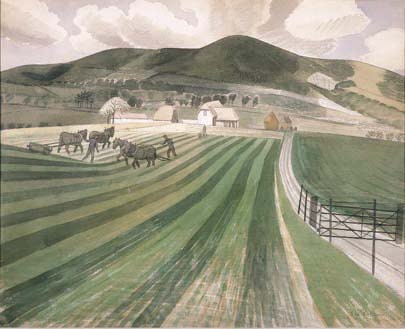
Jane: It would be the final scene, rooks at dusk somewhere in the South Downs, by Eric Ravilious 


  • Great - so here is an Eric Ravilious, of Mount Caburn near Lewes - and then a gorgeous pic of rooks at dusk from a rather lovely blog. 

Mount Caburn, by Eric Ravilious

Rooks at dusk from http://walkinginnorfolkandsuffolk.blogspot.co.uk


  • Thank you for answering all my questions so generously, especially as the birth of grand-babies, and family weddings have been taking up your energies! I wish 'Rook' oodles of good fortune in its flight.