Friday, 28 October 2011

'ANY HUMAN FACE' - CHATTING TO CHARLES LAMBERT


VG: Hi Charles - I so enjoyed 'Any Human Face'. It is lovely to be able to natter to you here to celebrate in a small way the publication of the paperback! So. Can you tell me about that title, first of all... where does it come from?

CL: I’d already written the first few chapters when I came across this phrase in Marilynne Robinson’s 'Gilead' –
Any human face is a claim on you, because you can’t help but understand the singularity of it, the courage and loneliness of it.

I knew at once that I’d found the novel’s epigraph and title. Any is an ambiguous word in a way – it’s almost an antagonym in that it conveys a sense of what unites us and what distinguishes us – it’s singular, questioning and yet universal. At that point, the (very much) working title was 'Mug Shots', in reference to the exhibition of police photographs at the centre of the novel, but I knew that wasn’t what I wanted; if nothing else, the tone was entirely wrong.

VG: Yes - although it would have worked - it really jars! Too simplistic, perhaps, when the novel is anything but. It is quite complex. You do have to keep your wits about you, I find -all the different threads interweaving.


CL: By the time I read 'Gilead' (which I loved, by the way) I already had the three main narrative threads – based on Andrew, middle-aged bookseller, Alex, aspiring rent-boy, and the Girl – I was looking for something that would bring them together in a non-narrative way, and what Robinson was saying fitted perfectly. I was particularly attracted to the way she placed courage and loneliness side by side, as though they were two aspects of the same thing, because that was where the book was heading. I felt that I’d found corroboration.

VG: …Aha. isn't it a magical thing when a writer we may never meet in person seems to hold out a hand and shake the one that holds our writer's pen? As we've been discussing behind the scenes, this recurrent thread of loneliness that crops up again and again - that certainly seemed a very important theme. Was that deliberate - or was it something that emerged as you wrote? Looking back, was it always running beneath the surface layers?


CL: Yes, loneliness is certainly an issue in the book, and it’s something I absolutely hadn’t planned. I’d thought the heart of the book would be impotence in the face of mysterious, indifferent power structures (which is what I always seem to come back to!) But the more I wrote – and learnt - about Andrew the more his isolation seemed to be central to his understanding of the world. I’m lucky enough not to have experienced much loneliness these past few decades, and my memories of the kind of crushing, annihilating – and thank God, transient – loneliness I suffered as a teenager and in my twenties – a loneliness I remember now with a kind of shocked wonder – didn’t really help me with Andrew (although they did with Alex).

What interested me about Andrew’s life was the way being alone can simply happen, and bring with it a sort of resignation that damps everything down; the state of his flat is a case in point, as is the (I hope) rather poignant episode of internet sex, interrupted by the arrival of the stray cat. What I didn’t want to do, though, was give the impression that being gay necessarily leads to loneliness, any more than selling books for a living does, or living in Rome. It was important to me that Andrew, despite his passivity, be given a way out of his loneliness, so the way the novel ends didn’t just meet a narrative need by tying up loose ends; it made emotional sense as well. In a sense it brought loneliness and courage together just as the epigraph does.

Alex (by this time Sandro) also knows what it’s like to be alone, loveless, and in a foreign city, and there’s a sense of loss about the book that isn’t just to do with the fact that the first chapter ends with a murder. As the novel develops, there’s a death – and resurrection – of the spirit, if that isn’t too grand a term. I hope the feeling the book leaves in the reader isn’t of hopelessness, because that isn’t at all what I want and it wouldn’t do justice to Robinson’s epigraph. I like to think that courage can be rewarded, although it isn’t always, and that Alex/Sandro is as resourceful as I would like to be in his situation.

VG: I certainly didn't feel 'hopeless' at the end. The ending came as a shock - and I won't give it away (!) - but the overriding feeling is 'its the journey that matters, not always the end of the journey..' if that isn't too airy fairy. Much of the book is colourful, tantalising...and you take that with you at the end. Life is like that, I guess.


CL: I also found myself wanting the Birdman, a character who played a much more substantial part than I’d originally intended (although he also plays a central role in a still unpublished novel of mine, entitled The Apprentice, and set in a considerably darker Rome than the one in Any Human Face), to represent the sort of gregarious and accommodating affection I’ve found in parts of the gay world. He’s a mother hen, clucking over his chicks and meeting their needs, albeit in a fairly seedy way, and it’s only right that his affection be reciprocated.

VG: I loved the character of the Birdman - an immensely engaging figure, seedy or not. Hugely generous in so many ways, and something of an innocent - I liked the way he sits where several characters intersect. And yet, he is also isolated - maybe that is pointed up y the birds - I don't know. It's just what I felt. There are so many types of isolation in this story...culminating of course in the darkest - that of the Girl.


CL: The isolation of the Girl is of a different kind. It has nothing to do with loneliness and everything to do with the deliberate privation of freedom, and it’s mirrored in Andrew’s predicament in the second half of the novel. I don’t want to say too much about this for obvious reasons, but the tensions set up between a solitude that’s self-willed or, at least, self-created and one that’s imposed from without are the driving force behind the novel, and the point at which the personal and political, for want of a better word, meet.


VG: Reading 'Any Human Face' was a powerful experience. It transported me not only to the underbelly of a city I know only very slightly - but also across time, opening windows onto the lives of characters who I still think about, even though I read the book some months back. There are so many questions posed, and half-answered - especially questions surrounding the central images, portraits, photographs whose origin is suspect. I found myself pondering - who 'owns' ones face? One seen, once photographed - does our likeness belong elsewhere as well as to us? And it has echoes of ancient concerns about the soul somehow being damaged if an image of a face is taken...

.I'll stop nattering to myself! Charles, thank you so much for chatting, and for writing AHF. I do hope we are lucky enough to see the next novel in line before too long...


Buy the paperback 'Any Human Face' - now available on Amazon!
and
Follow Charles Lambert on his blog, HERE.

Saturday, 22 October 2011

VAULT - DAVID ROSE'S ANTI-NOVEL


A while back, Salt Publishing kindly send me a pre-publication copy of ‘Vault’ to read for comment and review. I started it and enjoyed it – but life kept getting in the way more than once or twice - as those who have followed the goings on in my life (version 2011) will know. ‘Vault’ has been sitting patiently on my desk, waiting for me to read it again this time with no interruptions – and with many apologies to both David Rose and to Salt, finally, yippee!

‘Vault’, published earlier this year by Salt under its Modern Fiction wing, edited by Nicholas Royle, is an anti-novel. What IS an anti-novel? Was this a clever device intended to catch the eye, or was it really something working against what we expect when we read a novel? I think that yes, on one level it really is an anti-novel. It works like this. The main character of this novel, (for it is one, and a clever one) steps out of the realm of fiction, clothes himself in fact, and thus clothed, peers back into the unfolding narrative as the facts of his life are shaken and embroidered by the novelist. What novelist? Not this one – not David Rose – but another character, a novelist we never meet, a novelist who is repeatedly taken to task by the ‘real’ main character for playing fast and loose with a life that needs no embroidering.
Sounds complex – no, not really. It is logical, there is a pleasing pattern to the pieces which reel out like something dancing round inside a zoetrope. Or, to use yet another analogy, it is a Moebius strip of a novel. Whatever image I use, it is a novel I much enjoyed, as much for its originality as for its prose, its balance, and of course, the story that underpins the whole.
David Rose has carved out a reputation as a gifted writer of short fiction, and it struck me more than once that those skills were strongly at play in “Vault”. The work is short and to the point, but it is also complex, and the reader does need to work to make their way through the maze. I like that! I must admit, though, had I not been helped by the description of the book on the back cover, I might have got a tad lost, and had to retrace my steps.
So, basically –
The main character is a cyclist who becomes a wartime sniper, then returns after the war to dispense aid and occasionally retribution. He then becomes a somewhat unwilling post-war nuclear spy, seems to me. Perfect material for a novel indeed, and sure enough, the novel is there, or sections thereof. Only he does not approve of the way his experiences have been embroidered, and cheapened, as his life has been turned from actual to fiction. So we have a pattern of ‘memoir’ then fiction – which switches to fiction then comment via memoir. The voices are distinct. The ‘novel’ sections are a little more 'writerly', as the unseen novelist stretches to make the events seem more exciting, more colourful. The voice of the memoir sections (for want of a better word) is flatter, factual. It is extremely easy to forget that one is, in fact reading a novel with a novel within it...hence the Moebius strip analogy – which probably does not hold water – but what’s wrong with a good jumble of ill-at-ease mixed metaphors when describing ‘Vault’, which does not lend itself to simple description?!
I am very glad I read this book. It is a very clever, very interesting, original short novel, which rewards a close read in spades. I can recommend!

You can read the first four sections here on the Salt website. You can buy it from the same place, and all the usual suspects online.

-----
Added: I have been nattering with David Rose since posting this review - and was fascinated by some of the info in one of his messages - so with permission, as this adds hugely to the overview of the book and refers to one of my own best inspirations, W G Sebald :
I haven't reread Vault since I wrote it, nearly 10 years ago, except to proofread, as I hate rereading my own work, so I forget sometimes that it may be more challenging than was intended; several people told me they read it twice, which may be worrying.
The initial idea was based on fact, i.e. someone responding to a novel of their life - you may remember it: the woman who claimed that W.G. Sebald had used her lifestory for his novel Austerlitz, which he admitted to.
That's all I had to work with - the unease at one's life, and more importantly, one's death being appropriated. The plot was constructed as I went along. I have done a fair bit of cycling, so decided to use that for authenticity, although the pre-war history needed research. As did all the rest - sniping, the battles scenes, the post-war CND marches, which I just remember...
I gather a lot more elements got mixed in as I wrote, the density accumulating in the writing act, which I am sure you have experienced, especially in your new novel.

Friday, 21 October 2011

PUBLICATION LOOMS!

Well it does a sort of loomlet. 2 weeks to go. Launch party, publication date and how I feel about it all, over on The Coward's Journey.
And news of a glowingly positive pre-pub review on Booklist in the USA - which culminates thus:

The author’s Welsh upbringing is evident in everything from the lyrical cadences of her characters’ speech to the names of the small town’s neighborhoods and conjures a genuine sense of place. By using an ensemble cast to give multiple perspectives on the event that dominates the town’s history, Gebbie puts a prodigious narrative skill on full display.


Can't ask for more, really.

(Booklist, my friend Wikipedia tells me, is, " a publication of the American Library Association that provides critical reviews of books and audiovisual materials for all ages. It is geared toward libraries and booksellers and is available in print (ISSN 0006-7386) or online.")

Thursday, 13 October 2011

SUCCESS FOR COLLEAGUES!

Two erstwhile writing colleagues from The Fiction Workhouse of old (My online writing home for a few years - a small closed writing group) have contacted me with brilliant news. I am sooo pleased for them, hardworking writers both.

Chelsey Flood, first - writing now as C J Flood. I met her at Exeter at the launch party of the first Riptide Journal, loved her work, and when she said she did not have a writing group, but would like to work with a good one, invited her to join. Now, a few years down the line, and after time spent at UEA as well, she's emailed to tell me that she's landed a fantastic deal for two YA novels with Simon and Schuster and a German publisher. Both the English and the German rights went to separate auctions. 'Silverweed' (or whatever the final title is) is going to be a real hit! Chelsey blogs here, at C J Flood.

You can read an old bio, hear her reading her story 'The Grief Benches' here, on Route Online... Posted this because its nice to hear, and a good story - but also, look at that bio. We were all there once, with a few publications - then wham! Fab, and I am delighted!

Michael Logan next. I judged the Fish One-Page comp back in the dark ages, and awarded this story, I Will Go Ahead and Wait for You, First Prize. Michael doesn't live round these parts - currently, he is based in Kenya - and he couldn't attend the Fish prizegiving in Bantry - so I offered to read the story for him. We ended up corresponding, and he too joined the FW for a while. Michael emailed to let me know he had won Terry Pratchett's 'Anywhere but here, Anywhen but now...' novel competition and yup - another success. Here he is, (on the left) with Terry Pratchett and the other winner, also a Logan, coincidence!)
Michael's novel 'Apocalypse Cow' (fantastic title - a tale of zombie animals...) is to be published in May 2012 by Transworld. He blogs HERE.

Who says I can't pick a good writer when I see one!

Tuesday, 4 October 2011

BBC SHORT STORY AWARD BASH

The 2011 winner, D W Wilson
Runner-up Jon McGregor
finalist Alison MacLeod
finalist K J Orr
finalist M J Hyland
And which event did I not include in the last post, held on Monday 26th in London, and to which I stumbled through a sudden downpour that had people making a dash for trains, doorways, in water that spilled over the pavement it came down that fast?

The BBC National Short Story Award Prize Giving Event. The short story world is very small -everyone seems to know or know of everyone else and I knew three of the shortlist. Alison MacLeod, Katherine Orr, and Jon McGregor. Jon and I share an editor, Alison is author of one of the chapters in Short Circuit, generous lady - and Katherine Orr I'd met at Small Wonder, properly. Stunning stories all.
A boozy bash, but I never knew short story writers and editors could be so NOISY! And BBC Radio 4s Front Row programme was going out live in the midst, so 'herding cats and asking a mob of crows to be quiet please,' seems to be a good analogy. Still, quiet we were. To hear speeches, including an odd confession from Gwynneth Williams, read from a paper tugged from her pocket, about how much she loves fiction and how vital it is...the applause was er- muted. Lions' den stuff, brave woman.

It was fairly nailbiting. Silence fell. We cheered to order as the programme was announced. And this year's prize went to Canadian writer D W Wilson. 'Front Row' continued with a recorded something or other, and we returned to the wine.
Great to see Clare Hey of Shortfire, Diana Reich, organiser of Small Wonder, reviewer David Hebblethwaite, writer Adam Marek - and of course the Bloomsbury team supporting Jon.
Congrats to all indeed.

Sunday, 2 October 2011

THE GOOD LIFE

This pic courtesy of The Paper Princess, Yasmine Hussain
.
Wednesday 28th - the first ever reading, nay, the World Premiere of The Coward's tale, courtesy of Damian Barr and the Aubin & Wills Westbourne Grove Literary Salon. Playing to a packed house, with chairs set among the jumpers, suits and hacking jackets, Eleanor Moran and I both read and then had a natter with Damian, took questions form the floor. It all seemed to go down well, I had a smashing time, dinner afterwards with some ardent followers (not of me, of Damian!) and back to my club. Ahem. Thank to the Bedford Four too, for coming down special!

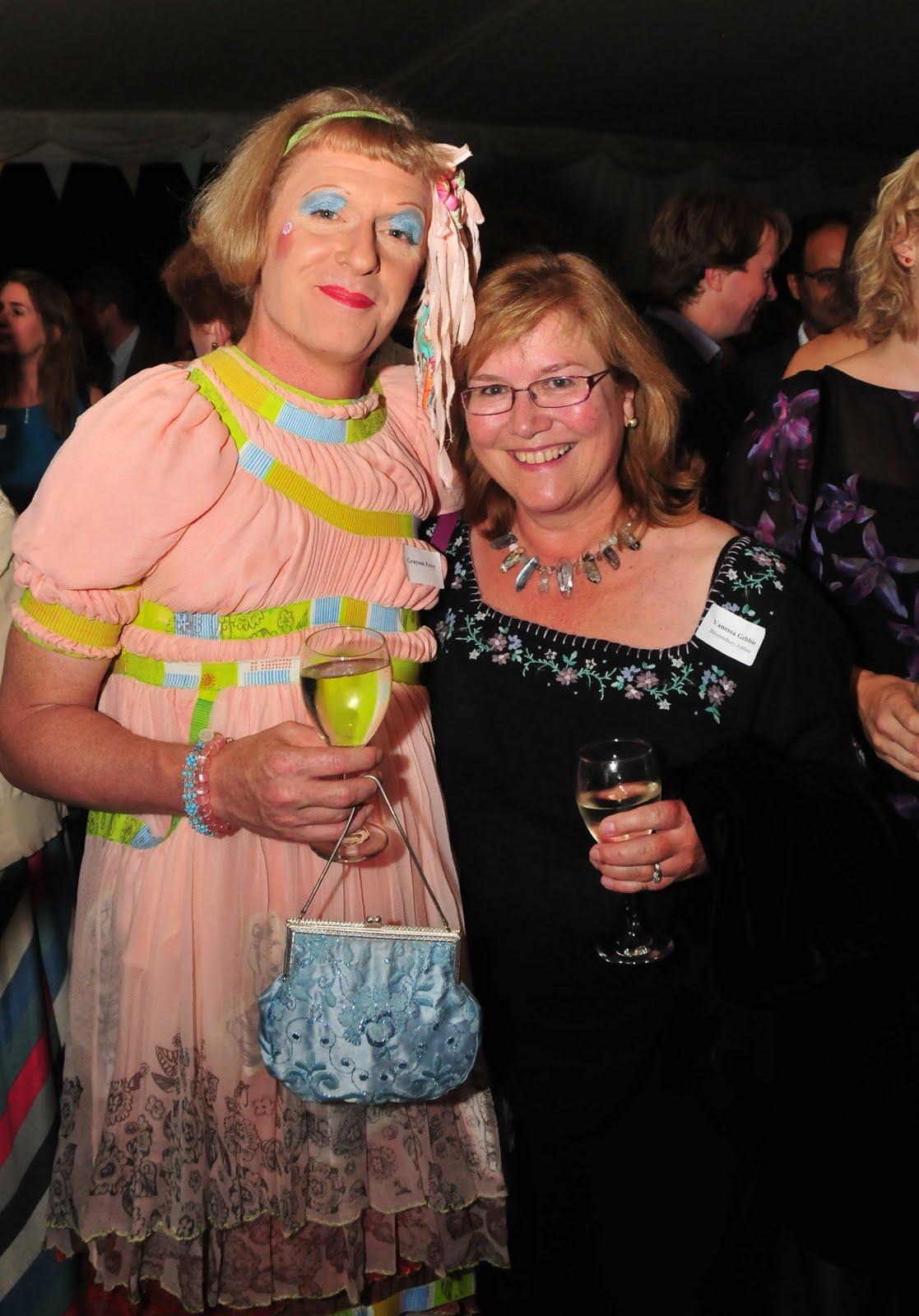
I got to meet and natter to an artist I have admired for a long time - Greyson Perry. We met at Bloomsbury's 25th Birthday bash, which, in true style, covered the centre of Bedford Square in London in a marquee and filled it with over 1000 authors past present and future, publishers, agents, printers, literary reviewers, illustrators, and oodles more.

For Dutch courage, the lovely Claire King met me at The New Cavendish Club (I have associate membership thanks to my membership of SWWJ) and we downed a G and T before heading off eastwards in a taxi. I regressed, unashamedly, into a teenage celeb-spotter. Lovely to see my buddy Andrew, my agent Euan, my editor Helen, the paperback editor Tram-Anh (which means Wise One), and to meet Jane Rusbridge and Precious Williams for the first time, Marika Cobbold for the second time, Selma Dabbagh for the at least third time, Jeremy Osborne of Sweet Talk for the first time, to eat finger food by the best (including haggis in a roll - which for a hot evening, was amazing!) -drink endless champagne. Happy Birthday Bloomsbury, and here's to the next 25. Who knows, with luck and a following wind, I'll be there at the 50th. In my zimmer.
,
And here is the paperback cover sent to me by Tram-Anh. With a few tweaks, including adding Rhymney Beers to the hotel signs, its smashing!

Monday, 19 September 2011

TILTON HOUSE WEEKEND RETREAT FOR WOMEN WRITERS


RECIPE FOR A GOOD WEEKEND.
Take one very beautiful house in a lovely garden, hidden away at the foot of the South Downs, once the home of the economist Maynard Keynes and his Russian ballerina wife.


Add eleven women writers, of all sorts. Here's ten of them - Beginners to established, poets and story-writers, novelists and playwrights. Performance workers and editors. Journalists and imaginers...
Mix gently.
Talke a gifted chef called John, who runs a vegan/vegetarian catering company called Cashew Catering, (not that many of us were even vegetarians, but happy to try...!) and a lovely farmhouse kitchen in which to experience zingy healthy tastes, like stuffed mushrooms, or fruit or savoury crumbles topped with nuts and seeds, fresh soups,

extraordinary brown breads, pretty salads topped with flower petals and whole flowers. Cous cous with roast vegetables, ad inf. Stir the writers in gently, with a large glass of something relaxing, white, red or maybe rose.
Put a writing tutor in the centre, who knows what its like to fight for time to write in among the other calls on one's time - partners, kids, other family, friends, housework ("What housework?" my family are yelling...) Who knows how hard it is sometimes to remember what a gift it is to be able to create.


And who knows how important it is to be given permission to do exactly what you need to do creatively - and to be challenged when you're ready and not before, shifted out of your comfort zone when you want to be challenged.
Leave to warm for 48 hours - two days and nights. At intervals, add in a workshop - with the best writing exercises the tutor knows, appropriate for everyone. Visualisations to open up new scenarios, voices, emotions. Word games to create new connections. Scenarios full of details left out, for you to fill in - to help create living, breathing characters. Maybe a Bedtime Story by the fire at the end of the day to lull you to sleep (or not, if it is funny...).
Throw in a private tour round Charleston Farmhouse, home of the Bloomsbury set, Virginia Woolf's sister Vanessa Bell, Duncan Grant, Roger Fry and later on Clive Bell.
Point writers in the direction of Berwick Church, where the Bloomsbury crowd created murals in which every face is one of their friends, or neighbours. Or go for a walk through the farmyard, skirting the fields, along the old coach road, across more fields, and back home.
Finally, add inspiring guests who will share a meal, and wine, and talk to us, then answer questions until the questions run out. Firstly, a successful female poly-talented writer actress and director, playwright, and novelist, Carole Hayman, she of the stunning Pre-Raphaelite hair, and co-creator of 'Ladies of Letters', among other things. (Who tells us that Fay Weldon reckons you ought to be able to write your novel in 3 weeks if you focus hard enough). Secondly, a top publisher. Helen Garnons-Williams, Editorial Director of Bloomsbury, to give us the insiders' view of the publishing world. What commissioning editors are looking for. The huge benefits of having an agent. And the topsy-turvy world that is e-books. (See us all chatting before Sunday lunch, on the lawn, in one of the first pics above.)

Check for consistency. Be told that every participant had achieved or surpassed their personal objectives. Feel very delighted, and enjoy all the new friendships made, the shared inspirations, the hopes to met again soon.
Retire to bed on the third day absolutely knackered.

----------
Leftovers can be enjoyed, gently warmed for a few days. Especially while reading unsolicited feedback sent to New Writing South, like these snippets:

Just a note to say how much I (and, I am sure, everyone) enjoyed this last weekend at Tilton. It was easily the best writing event I have attended in all respects and I came away inspired!


Just a quick thank you for a wonderful writing retreat - I think that you and Vanessa gauged it perfectly - well done!


I had no idea that this was the first writing retreat that New Writing South had organised - it all looked very professional but I'm sure there was a lot of hard work involved.
It was the best writing workshop I've been on - inspiring tutor, perfect setting, delicious and healthy food and lots of time and space to write. I feel as if I've come back with a treasure trove of energy and ideas to keep me going through the winter.
So thank you.

Thursday, 15 September 2011

Look! My book!


That's all - just a whole box of the beautiful Coward's Tales...sigh. Its gorgeous. Silvery shining leaves, feathers, river, a village and mountain, statue, old man and boy. And a rather stunning fish.
(Thanks to Stephen Moran for turning the pic round, otherwise you'd have had to look at the book backwards... like this...!
heee!
I'm allowed to be excited - 'The Coward's Tale' is on the Bookseller's Choice list for November, thanks to a nomination from the lovely people at the Torbay Bookshop. And it's been reviewed by A N Wilson for a future issue of Reader's Digest... positively, one gathers.

Anam Cara is booked for late Jan early Feb - I need to write!

Monday, 12 September 2011

INTERVIEW WITH NEIL BLOWER - THE REAL TOMMY ATKINS


Neil Blower.

My second short story collection, 'Storm Warning' was written for my father, a man who was awarded the MC in WWII. He died in May, at 95. Dad was naturally a gentle man, and he never quite got over some of the events he'd witnessed and had to take part in. I wanted to explore in fiction the aftershocks of conflict, to show the different ways in which those caught up in conflict of many kinds can be changed - and I have been pleased with the response to my book.
But then I heard on Twitter of the novelist Neil Blower, who goes under the name @realtommyatkins - a guy who has not only experienced conflict first hand, but who has written a novel partly in an attempt to combat the after-effects - and I badly wanted to read his book. Thanks very much to the publishers for sending me a copy.
'Shell Shock, Diary of Tommy Atkins' is published by Firestep Press, and the publisher says this:
This short, diary-style novel, by a British army veteran chronicles the difficulties faced by Tommy, a 23-year-old squaddie, as he desperately tries to conquer post traumatic stress disorder (PTSD) – shell shock. His over-emotional responses to the stresses of everyday life – post-office queues, a trip to Ikea, and his relationship with his family and girlfriend – eventually lead to alienation and suicidal urges.
Told in the vernacular, with humour and personal understanding, the story highlights the work of the Charity Combat Stress in rehabilitating returning troops.


'Shell Shock, Diary of Tommy Atkins' comes out from Firestep Press on October 1st. On Firestep's website you can read the very strong endorsements this book has already received from senior figures in the forces. It is a short novel, and certainly not sweet. It is a quick read, and one that most readers will find hard to forget. It is an important novel, and I'd urge readers of this blog to go off and buy it - you are also giving a donation to a fabulously worthwhile charity, Combat Stress. But more of that later.
Shell Shock's main character is Tommy Atkins - named of course after the nickname given to British soldiers in WWI.But this is not then, it is now. very much so. This particular Tommy Atkins, in his early 20s, has been discharged from the Army suffering from Post Traumatic Stress Disorder. He goes home to parents whose marriage is fragile - and to a girlfriend, Shell, who adores him and is glad to have him back. The novel is set, as the title suggests, like a diary, and very quickly I began to experience that strange voyeuristic feeling - 'I shouldn't be reading this' - as if I really was reading something intensely private. Tommy chronicles his every day experiences - his attempts to find employment, his working relationships, his relationship with Shell, and with his parents, the ups and downs that gradually become overwhelming. Is it weak to admit I was in tears in places? I don't think so.
As a fellow writer, I was absolutely captivated by the voice. It is clear, unforced, strong as hell, natural and absolutely believable, just the voice of an ordinary guy caught in an extraordinary situation -that's why I sank so easily into the role of observer, I think.
I knew a little about PTSD. Among other things, my own writing tutor suffered from this debilitating, hidden syndrome - hidden because nothing 'shows' - we like our injured people to wear bandages and splints so we can see where the trouble is, don't we? And my own father must have suffered for sixty years from a mild form of the same thing, on and off - something that got in the way of his everyday life after he left the Army in 1946. And in those days there was no help - nothing was recognised. You were expected to get on with things. Which he did. But my goodness - life could have been so much better for those men...
Now, having read 'Shell Shock', having got to know 'Tommy Atkins' through his diary, and the raw honesty with which Blower portrays his character, I can recognise so many things which affected my Dad - and I've never really put two and two together in such a clear way.
Reading round the subject - somewhere I read Neil Blower's acknowledgement that this is not a 'literary' novel - as if it ever ought to have been. Forcing it into a literary jacket would have been absolutely the wrong thing to do. I appreciate what he's done, I have huge respect for this rather special novel, which will not be easily pigeonholed, thank heavens. I also discovered that he is doing a degree - and that he has recently discovered that he is both dyslexic, and suffers from a condition on the autism spectrum.

ME: Neil was kind enough to natter to me for the blog - through his publicist. So thanks, Neil! First, can you give us a bit of background about yourself, your time in the forces and since?

NEIL:
I joined the army in 1999 and served five years with the Royal Tank Regiment, taking part in operations in Kosovo and the Iraq war. After I left the army I did a number of minimum wage jobs including security which I stayed doing until I decided to go to University. The thing about working in security is that over a 12 hour shift, especially nights, you have a lot of time to kill, so I read. I read books on everything from politics to history to physics, I'd always been a keen reader but mostly fiction. I wanted to know everything about everything, I'm convinced this has something to do with being around death and violence because before Iraq I had never really been interested in academic pursuits.


ME: I very much enjoyed reading 'Shell Shock, the Diary of Tommy Atkins' - I also found it very moving. What do you want your readers to feel after they've read your novel?

NEIL:
I hope they don't think it's garbage ha ha. Seriously though, if people read it and have a better understanding of what our soldiers have to face, not just at war but when they come home as well then I'd be happy.


ME: I read that you've suffered from PTSD yourself, and were advised to 'do something creative' to combat the stress. Was it a deliberate decision on your part to write fiction, as opposed to non-fiction/memoir? If so, why?

NEIL:
Yes it was very much a deliberate decision. I've always been into books since childhood. Then after I left the army and was told that creativity may help my condition that was the my first thought, I also played about with screenwriting. It started off as a hobby really, then I thought, maybe I could do it for real and someday get published, then it became an ambition and not to sound like a cliche, a dream. There's lots of things I want to write about, not just war or the military, but I think for me it's a good place to start.


ME: 'Shell Shock' is a real eye-opener. Two scenes in particular have stayed with me - firstly, when the Army doctor tells Tommy he's no longer under his care, almost 'abandoning' him. And second, when Shell's friends ask about killing. Both those scenes seem to underline the huge gulf between Tommy and others. Can you talk a bit about writing those scenes?

NEIL:
Well the bit about the Doctor is true, once you leave the forces that's it. You are someone else's problem. It's nothing personal, that's just the way it is. Like with the married accommodation, once you leave - you have to move out. Like many things in our society, it;s the rules that need changing. And as for the question about killing, I've had that a number of times "did you ever kill anyone?" I think with our general perception of war this is an obvious question, albeit a very insensitive and sometimes ignorant one. The vast majority of people will never, ever be put in a situation where they will have to end the life of another human being and I think this is why people ask. Also it has been glamourised and romanticised to a certain degree on TV and in films. In the new Bond films and the Bourne Franchise for example - the hero is a killer and has to live with it. I did write those scenes to highlight the gulf between soldiers and civilians.


ME: As I said on Twitter, I think Shell Shock is an 'important' novel. Were you aware of its importance as you were writing it - and if so did that help or hinder?

NEIL:
As I was writing it, I just wanted to make it as good and truthful as possible (and finish it). It was only after we started to get feedback and reviews that its importance crossed my mind and it's not really for me to say. I'd be very, very proud if it is considered an important novel though.


ME: You're doing a degree at the moment, I think, in English Lit/Creative writing? What's that like?

NEIL:
I'm really enjoying it, the learning feeds into my work, knowing what's gone before and being in that environment has really helped not only my creative side but my knowledge base as well. I'm the first person in my family to ever go to University so I'm proud just to be there.


ME: Tell me a bit about the dyslexia and the autism spectrum issue. If these had been picked up earlier on what difference would that have made?

NEIL:
I was absolutely mortified when I found out. I wanted to be a published author - how would this ever happen now? But then I thought, you know what, I can do this, it will happen. I don't think it would have made a difference if it was picked up earlier, I'd not really been in a situation where it mattered, it just means I see things differently than other people that's all.


ME: I hadn't heard of Combat Stress, the charity and I bet I'm not alone. I gather a not insubstantial donation (£1) is given to the charity for each copy of your novel that is sold...Would you like to say something about it and the work it does?

NEIL:
Combat Stress do a fantastic job. I think they are starting to get a higher profile. But I also think that over the coming decade PTSD will be a major issue in this country, the amount of people who have served in Iraq and Afghanistan coupled with the intensity of the fighting means that the number of PTSD sufferers will go through the roof and this in turn affects the NHS, welfare, crime, so it's important we recognise the condition and the organisations that can help.


ME: Anything else you'd like to natter about?

NEIL:
Ha ha, there's lots I could talk about but I'll save that for my novels. I just hope people enjoy Shell Shock and get something from it. And for in depth info about PTSD please see the website of Combat Stress .


ME Thanks Neil, very much, and loads of good luck with 'Shell Shock', and the next piece of work.

--------------------

Other reviews of 'Shell Shock' include this, on rearparty.co.uk

Copies of 'Shell Shock - the Diary of Tommy Atkins' can be bought from the usual suspects, including the Publisher, and Amazon-HERE. Don't forget, you are also giving a donation to Combat Stress, who are doing a fantastic and difficult job...

-------------------

Neil Blower is a British author, screenwriter and novelist based in Manchester.
He joined the British army when he left school and served five years with the Royal Tank Regiment. Serving on operations in Kosovo and the 2003 Invasion of Iraq.
Neil is currently studying for a degree in English literature and creative writing at the university of Salford.
His first book - Shell Shock: The diary of Tommy Atkins will be released in paperback October 2011 by Firestep Press - an imprint of Firestep publishing.
He is now working on his second book - My subject is war. A collection of short stories exploring the realities of contemporary conflict.
Neil is an avid reader, his favourite writers being Hemingway, James Joyce and Joseph Conrad.
He goes to the gym regularly and boxed in the army and is a big fight fan. He is also a big fan of film, anything from blockbusters to indie films. He is also a keen skier.
Neil is engaged to married to his partner of eight years Samantha, they live in Manchester with their young son.


-------------

And finally -having read this book, and talked with Neil, I decided to give all royalties from 'Storm Warning' to Combat Stress.

Friday, 2 September 2011

A week of #StoryGym


Last time I was away from Internet for a while, writers Tania Hershman and Claire King kindly stepped into the breach and invented suitably interesting prompts for the daily #StoryGym workout on Twitter, for those writers who want to.
Away again, so here's a week or so's worth just for fun!

1. Caught in the eye of the storm, carrying a child...

2. What was in the suitcase left on platform 12...

3. Her man the poet, her man the liar...

4. They meet in The George at Stamford, by mistake...

5. Supper served in a petri dish...

6. A small explosion in the garden shed...

7. He climbed to the top of the highest hill and howled...

8. "Tell me why the grass is green," he said, chewing his nails...

9. What was behind you when you looked in the mirror...


Have fun!