Sunday, 11 March 2012

A WRITER IN ATHENS


In October 2011, EUNIC (EU National Insititues of Culture) in Greece invited a female writer from each of several EU countries to write a short story exploring the issue of gender equality. I was delighted to be the UK writer for the project, and the others were Rea Galanaki (Greece), Marta Pessarodona (Spain), Dacia Maraini (Italy), Rina Katselli (Cyprus) and Annette Mapson (Norway).

The project was in collaboration with the General Secretariat for Gender Equality, Greek Ministry of Interior.
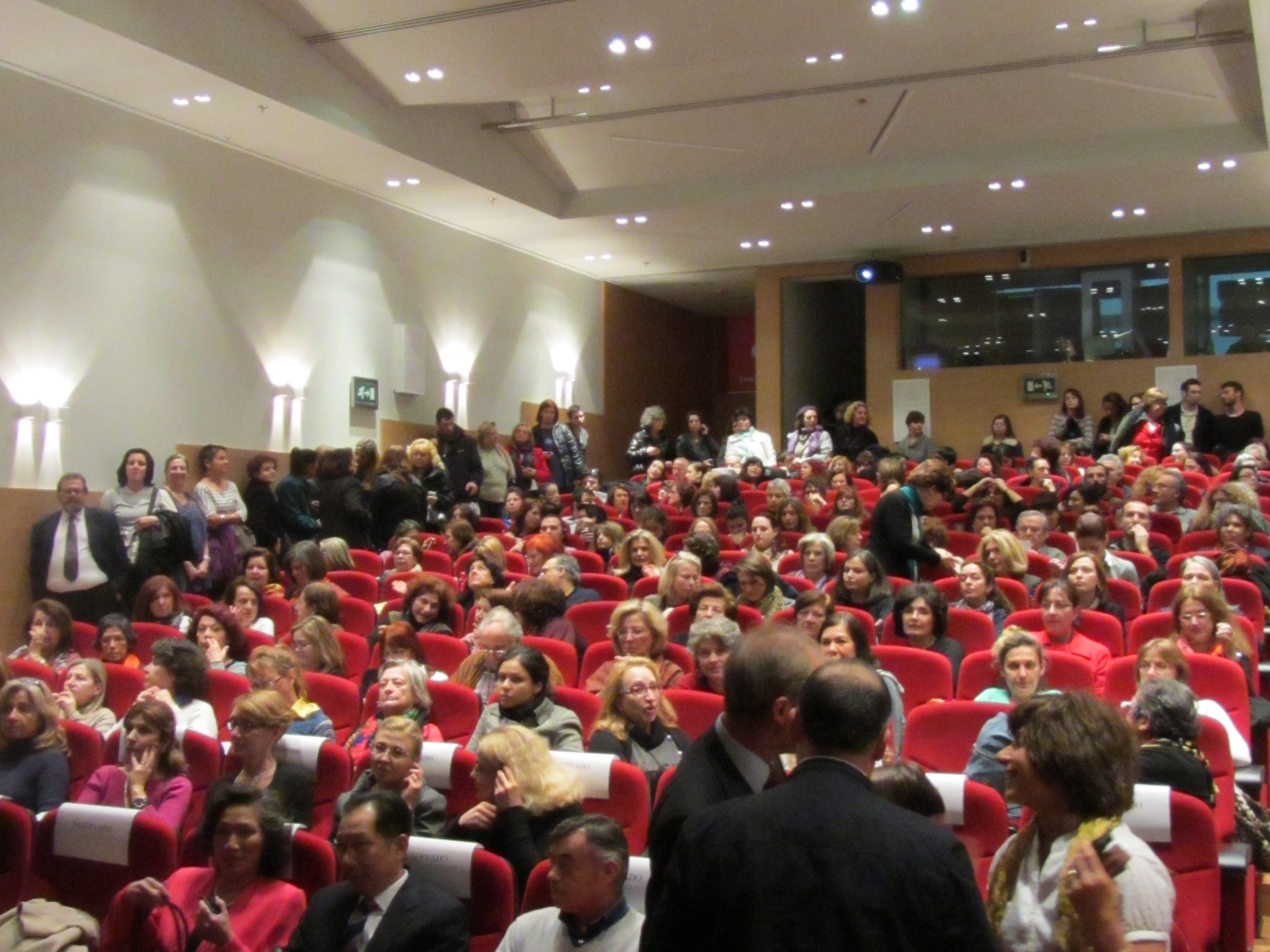
An anthology of our stories was published in Greece, and launched in Athens on March 8th, International Women’s Day.
Entitled ‘Six Women, Six Voices’, the initial idea had been to publish all the stories in Greek alongside each piece in its original language - but the economic situation meant that the whole project was under threat at one point, and in the end, funding was found to ensure its survival in Greek.

The launch was a public event, had been well-publicised, and was held in a packed lecture theatre at the Institute Cervantes. Even the steps were full. The Chair of EUNIC Greece, Eusebi Ayensa Prat, Director of the Instituto Cervantes de Atenas, welcomed everyone, and Maria Stratigaki, General Secretary for Gender Equality, made opening remarks. The discussion was chaired and facilitated by journalist Mary Adamopoulou from the newspaper Ta Nea.
My overwhelming sense was one of privilege to be part of such an important project. Amazed at the fast-filling auditorium, the simultaneous Greek-English translation preparations - ear-pieces just as if it was a United Nations meeting...
After introductions, I addressed the multitude first. I had ten minutes to speak, and could have chosen to tell the audience about myself, my work, but decided not to do that. I described my story, which is a (hopefully) comic fable. Then I described my own journey as a woman writer - being advised early on to write under a pseudonym if I wanted to be taken seriously by the literary establishment. Deciding not to, as that was dishonest. I'd take my chances. Calling reviews the ‘oxygen without which a book cannot breathe’, and going on to show VIDA 2011 Count statistics revealing a real skew, an imbalance in vital review space and in the gender of reviewers.
.
I was amazed at the high profile of International Women’s Day here and in other European countries. I have not been aware of such celebration and awareness in the UK. Why is that? Interesting too, to see in Internet discussion, the existence of a snippy male response in several places - mainly poking fun. Fascinating, as that only serves to point up the continued belittlement of women and their achievements in some quarters, just because they are...women!
I was interested to hear another of my panel colleagues, the Greek writer Rea Galanaki, suggesting that one of the many reasons for the male bias in the literary establishment is that some female writers do women no favours by writing ‘Harlequin’ romance-type work and other badly written books, therefore getting us all tarred with the same brush. I’ve heard that before and it amazes me. There are many blokes who produce action thrillers, not written well. Or horror. Not written well. And the literary establishment does not assume that every male writer is therefore a bad writer of horror/action thrillers. So, if the ‘Harlequin’ issue is indeed a belief, it does appear somewhat illogical.
I may not be a feminist with a capital 'f', but I defend the right of any writer, male or female, to write what they want. And, my own right to write, and read, what I want. I also have a right as a reader, to be shown a balanced selection of reviews...
Athens is such a fascinating place - I don’t think we get the correct impression in the UK. I was lucky enough to have a day free to visit - first a guided tour round the lovely Acropolis Museum, led by Christina Sordina, Culture and Information officer at the Royal Norwegian Embassy, Athens. On the top floor, the floor dedicated to the Parthenon, and mirroring the size, where the light is stunning, I watched a group of small school children being given a talk on the beautiful frieze. Most of what they were seeing is only plaster casts, kindly allowed by the owners - the UK’s ‘British’ museum - which is of course a museum holding precious few British artefacts at all, just everyone else’s. In the photo, the original section is darker. The rest is replica. Maybe many of these children will never see their heritage without paying to come and see it in London... I felt very bad.
Surely, lordly souvenir-hunting belongs to another age? Today, to give them back seems morally the right thing to do - especially as one of the main arguments against sending the sculptures home was that there was nowhere to house them. Now, the right house is ready. It is better in both design and situation than the one in which we are holding them captive. In crepuscular gloom.
More photos of Athens below.


Saturday, 3 March 2012

BRIAN GEORGE TALKS ABOUT "BLINDFOLD"


It is my pleasure to welcome a Welsh writer who is also a friend and writing colleague, Brian George, to me 'umblest of blogs. Brian's second collection, 'Blindfold' was published a few months back by Stonebridge Publications. This is Brian's second collection with them, and I must say their books are rather lovely - each is finished by hand, and has a ribbon bookmark - and comes with the guarantee that should anything untoward happen to damage the artefact - they will repair it until it is good as new. How's that for flying in the face of the soullessness of the e-book?

I had a nice time nattering to Brian about Blindfold - and I started by asking him to compare himself as a writer now with the writer he was on the publication of his first collection.

VG: Tell me how you think your work has changed since 'Labyrinth'.
BG: There are a couple of obvious things, I suppose. Most of the stories in Walking the Labyrinth were set in the south Wales valleys, and many of them explored issues around Welsh identity and culture. Only a few of the stories in Blindfold have valleys settings – though some of them are set in Cardiff – and there’s less of an attempt to explore those issues specific to post-industrial south Wales, for want of a better phrase. Many of the stories in this new collection are set elsewhere, or often have non-specific, sometimes vaguely surreal, settings. I’m really not sure why that should be the case, to be honest. Perhaps I felt I’d worked through some of those specific cultural issues in the previous collection, though it certainly wasn’t a conscious decision.
Another obvious difference is that most of the pieces are much shorter. I won’t say too much more about that here, as I know you’ve got a specific question about flash fiction coming up later!
More broadly, and linked to both these things, I’ve been trying to achieve greater compression, to cut away all but the most essential details and reduce each story to its fundamental core. Out with explanation and too much back story, that was my motto, I suppose!

VG: So, do you work in the same way at all?
BG: In some ways my methods of working have changed. Being lucky enough to participate in the Fiction Workhouse and the Fiction Forge (two wonderful online writers’ groups) over the last five years opened my eyes to new ways of working. I learned to work from prompts, to experiment and ‘let go’ a bit more in the initial act of writing, and then to radically prune and rework what transpired from that kind of exercise.
In other ways, though, I still work in the same way. There has to be some kind of itch, something that haunts me as a writer, something that these techniques of writing help me connect with. Inevitably, I suppose, some of these itches and hauntings change over time, while others remain constant.

VG:What is the broader significance of the title of this collection?
BG: Blindfold is the title of one of the stories, and on the surface it’s about a childhood game the two brothers in the story used to play, and which has now been adapted to help the damaged younger brother cope with an unbearable situation, to shut out a reality he can no longer face. In the context of that particular story, the ‘blindfolding’ can also be seen as a metaphor for the way the whole country was hoodwinked into supporting wars and military adventures in the recent past.
More widely, one writing colleague who has read the collection suggested it might be a metaphor for the way most of us muddle our way – with no particular sense of direction – through life. That wasn’t necessarily my conscious intention, but if that’s the way it strikes an intelligent reader, I’m happy to go along with that interpretation. Perhaps fiction – reading it and writing it – is ambivalent in that respect. It can enable us to see things more clearly on the one hand – to cut through all the stuff that obscures and gets in the way of understanding – but can also itself be a source of deception and self-deception. The phrase ‘telling stories’ can have all sorts of contradictory meanings.

VG: Many of the pieces of work are flash fiction. What is your definition of flash fiction, and what might be some good tips for writers who are new to it as a form?
BG: It’s very tricky to define flash fiction. I think if you put ten practitioners of the form in a room, you’d end up with twenty different definitions by the end of the discussion. At its simplest, it’s just very short fiction. People will squabble about how short that means, but for me, if it’s under a thousand words, you could call it flash fiction. Quite a lot of the pieces in Blindfold, though, are much shorter than that.
More important than the actual word count is the approach the writer adopts to telling a story. Very often in longer fiction, a writer takes pains to explain things – this happened, so then that had to happen; she did such-and-such because of so-and-so; oh, I should mention what happened to him five years ago, because that’ll help to explain why he’s now so wary of emotional commitment; and so on. Well, in flash fiction, you can’t do any of that. No explanation – that’s my one and only mantra! Strange things happen in flash. People act illogically. We see people from unusual and baffling angles, or we see them in fragments. Then, of course, the reader has to piece the fragments together. For this reason, some readers feel unsettled by flash.
At its best, though, this can all make for an extraordinary intensity – a real sense of cutting to the core of what a character, a situation, or life in general, is all about. The term ‘flash’ doesn’t just imply something that’s over in an instant, but also the experience of an extremely bright light being shone for that instant on something significant. The best flash fiction can do that, and can haunt you for years. If this is combined with a fastidious attention to language, a sort of poetic compression and allusiveness, then the results can be overwhelming. As you know, I’m always banging on about some of the short pieces by Jayne Anne Phillips, such as Under the Boardwalk or Solo Dancer, as examples that have stayed with me for years, or decades even, now.
The other thing I like about working with flash is that you can experiment with form in a way that can be very difficult in longer pieces.

VG: Tell me about Fibonacci sonnets.
BG: Well, this was one of the experiments in form I tried out in this book. I think the Fibonacci sonnet was ‘invented’ by an American writer of flash, Bruce Holland Rogers. Though it’s called a sonnet, it’s actually a prose form. The idea is that each sentence in the story has a prearranged number of words, following the Fibonacci sequence of numbers. You start with two sentences of a single word each, then gradually increase the length of sentences, before falling back in the same sequence in reverse order, and ending with two more single-word sentences. According to Rogers, this gives the piece roughly the same sort of balance as a Petrarchan sonnet!
Now, this may well sound like an abstruse and pointless exercise, like putting on a straitjacket, but what I actually found was the reverse. The underlying material of the piece I was writing was so raw and visceral that I found imposing a strict format like this on it – giving it a ‘cage’, if you like - controlled and intensified the emotional content. I’m not sure I’d want to write habitually within this kind of format, but I hope it worked in this particular instance.
And this is one of the beauties of flash fiction: it enables you to try out a great variety of voice and form.

VG: Nothing's ever perfect. If you could change one thing about the book, what would it be?
BG: Well, I often look back at individual stories, even after they’ve been published, and think I should have done this or that, this scene should have been expanded, that one left out altogether, that adjective should definitely not be there, you know the kind of thing! I wanted to make little adjustments to stories even as I was reading them out at the book launch, to be honest.
In terms of the collection as a whole, while it’s not a ‘themed collection’ in the way that’s usually understood – one consistent setting, recurring characters, and so on – there are lots of connections between the stories, some obvious, others more obscure. When I was discussing the running order of the stories in the book with Mike Byrne, the publisher, we decided not to signpost these connections too heavy-handedly, but to allow the reader to make the connections themselves. On reflection, I think we could perhaps have given a few more clues through the way we juxtaposed some of the stories.
Though there is certainly a lot to be said for getting the reader to do a bit of work!


VG: I have a copy to give away as a prize - can you think of a question to ask readers, and you choose the best reply, perhaps?
BG: What’s the best flash you’ve ever read? Explain what it means to you in no more than a hundred words.


There you go dear reader-person! Tell us about the best flash you've ever read - here. Maybe, if it was online, you could leave a link. Look forward! And finally, if you would like to order a copy of this book (highly, highly recommended) please email Brian George on briangeorge711 AT btinternet DOT com or Stonebridge Publications on anni AT wiltonjones DOT fsnet.co.uk.

Monday, 27 February 2012

TWIDDLING THUMBS....HOW ABOUT AN OUT-TAKE COMPETITION?


The Coward's Tale comes out in the USA today, and I am several thousand miles away, twiddling my thumbs. This is a bit like knowing your offspring is appearing in their first school play, and not going. How many times do you have a book out in the US?

So let's have a competition to cheer me up. PRIZE? A signed copy of the US edition of The Coward's Tale, with a difference. I will include an out-take. A scene that didn't end up in the book, stuck in the back. And this out take will not appear anywhere else. Promise.

So - what you have to do is this - cheer up a writer with no party to go to, by suggesting how she can celebrate the publication of a book on the other side of the world. The best suggestion, I will do - with pictures to prove it- so don't make the suggestions grubby please.

Rules.

Suggestions must be suitable for a not-young personage.
Suggestions must cost no more than £5
Suggestions must not entail removal of clothing.
Suggestions must not entail losing consciousness for any reason.

If none of the ideas cheer me up, no one wins.

Deal?

Friday, 24 February 2012

PUBLICATION IN THE US LOOMS...


The US edition of The Coward's tale is on the chocks, and comes out officially early next week, although I think they are shipping already! With thanks to my US editor Kathy Belden and the Bloomsbury team in New York.

And two US literary blog reviews came in recently. First, a site called Seeing the World Through Books. Quite a fantastic website, a goldmine of in-depth reviews of books set in countries other than the US. The owner, Mary Whipple begins her amazing review thus:
"It has been two years since I have added a new book to my list of All-Time Favorites, but that has just changed with the release of this novel which deserves a special place on my Favorites list. Set in the mining country of southern Wales, Vanessa Gebbie’s incandescent new novel captures the cadences and speech patterns that lovers of Dylan Thomas’s Under Milk Wood have celebrated for years, and as I read the book (as slowly as possible), I felt as if Richard Burton, the Welsh narrator of Under Milk Wood, were whispering in my ear."

Please follow the link above for the whole review. I am particularly moved to see she has sourced pictures of the Gleision colliery disaster last September to underline the fact that mining tragedies are not a thing of the past.
.
And secondly, a site called Tzer Island, where the review begins:
"When we take the time to look beneath the surface, people are not always what they seem to be. Sometimes those who seem cowardly are not cowards at all. Sometimes atonement is mistaken for guilt. In her unapologetically humane novel, Vanessa Gebbie reminds us of the patience and effort that is required to understand another person, and of the rewards awaiting those who make the effort."

and it ends:
"Gebbie writes musically rhythmic prose, forming sentences as sharp and shimmery as broken glass. Both instyle and content, The Coward’s Tale is an outstanding novel".

The complete review is via the link above. Another terrific website.

BARNES & NOBLE LINK - for easy purchase in the USA.

Wednesday, 22 February 2012

POETRY AT TATE MODERN


Highlight of this week has been the first in a series of six workshops held at Tate Modern, led by poet Pascale Petit. I attended one term of these wonderful workshops a couple of years ago, and loved the whole experience. It is a privilege to work with Pascale, and with the other participants - but what makes these even more special is the place.
We meet when Tate Modern has closed, creeping in through a side door, and go to the chosen exhibition. There, twenty or so writers gather to take inspiration from being in privileged proximity to works of art, installations, by some of the world’s greatest artists.
Monday evening saw us in the Yayoi Kusama exhibition - not someone I was familiar with at all. Surrounded initially by colourful canvasses, which this octogenarian paints on a table, flat - it was an extraordinary enough experience, coming to terms with the images - black cartoon-like profiles, strange eyes, spiky fruit-like shapes, face upon face upon face, naif images - someone called it ‘aboriginal art’ whatever that means - all black on primary colours.
Then the installations, where we spent five silent minutes, soaking up the scene. First a half-lit domestic interior, complete with sofa and table set for supper, bookshelves, sideboard - everything covered in small neon dots, and lit by ultra-violet - like being in a still from a strange, empty home disco with a multi-coloured disco ball doing its thing!
Then the best (for this writer) an infinity mirror of a room, a myriad of tiny suspended lights that changed colour, a reflecting floor, and you were held somehow between there and here, up and down, and after a while, Kusama’s objective of obliteration of self came a little closer.
We wrote poems in response, and shared them - sharing lines, picking up lines written bythe artist as inspiration, if we wanted. And homework was to create a mirror poem. Or ‘specular’ poem. Never heard of this, and it is such fun to try out - a two stanza poem, in which the second mirrors the first, exactly. No words change - but punctuation can.

There is an example, by the poet who is credited with giving the name to the form, and making it her own, Julia Copus, here:

Wednesday, 15 February 2012

TIM LOVE ON POETRY, CRICKET, EGYPT et al.


Been considering poetry, and what I like and why. So - I enjoy poems that don’t let you go - ones that keep asking their questions, making you puzzle at them, even when they are couched in perfectly lucid language. I can’t be doing with poetry where the poet is standing in front waving a red flag, shouting about their erudition. I prefer clean, lucid language - and in the end, the success of those poems relies on originality of vision. Anyone can swallow a thesaurus and play at word-jigsaws. NOT anyone can ‘see’ in an interesting engaging way.
Take Tim Love’s ‘Moving Parts’, published in 2010 by Happenstance. Tim’s writing intrigues, and delivers over and over again, as each time the poems give up new twists, because he sees things in a way that fascinates me (and him, one assumes!). I sometimes take this collection with me on train journeys - it always gives up something I hadn’t noticed before.

I’m not happy reviewing poetry - and the reasons for that may be found here on Happenstance blog - Instead, I asked Tim if he’d talk about one of the pieces I like most - a poem called ‘Escape’.

Here is the poem, reprinted with permission: (with my choice of image)


Escape

As you backstroke in the hotel's outdoor pool,
your blue eyes look like holes.
I notice by the perimeter
a legless man on a skateboard slurping a lolly.
It's a last-minute break from snow's routine to Cairo,
where more lost air-luggage ends up than anywhere else.

We cool off reading in the bar's ticking wickerwork,
the Gaggia's chshsh like rush-hour airbrakes.
Persian architects fled here from Mogol raids,
bringing their blue temple domes painted with stars.
Nile crocodiles are colourblind, they can't see blue,
but I can see the legless man's still staring through the gate.

I shake the sugar sachet before tearing it.
Sometimes feeling precedes a reason, a phantom-limbed sadness,
just stratospheric dust refracting, evening suddenly falling.
They've proved that lab rats dream of their mazes.
I dream of a brass doorknob whose dimple
my thumb always finds.

It's 3am. The night sky listens in awe
to the symphony of what it must do.
The moon's a black and white flashback
perfecting the city's form. I magnify the moment,
hold an uncorked bottle to my mouth
two-handed like a clarinet and play the blues.


VG: Tim, this is my favourite poem in 'Moving Parts' and is one I keep going back to
again and again, and not just because it is in the middle!

TL: ‘Escape’ has received the most attention - it's pivotal according to one reviewer. It has the most-quoted lines too. It was written years before I visited Egypt though (in 2001) and appeared in Seam. Don't know how many of the questions I'll be able to answer though.

Here is an old and rather literal movie of the poem.

VG: No problems, and thats great to see - surprising, really - and yes, very literal. It is nice to hear it read by the writer - and a surprise - the first stanza is completely different - some of the same images but in a different order. Memo to self - ask about that later. But Hmm - would you prefer starting with another poem? I'm glad others have picked this one, in a way - it validates something in the way I'm seeing/appreciating poetry - although quite what, I'm not sure. 
Without pre-empting the questions that might arise, themes of otherness might surface.  the world experienced as through a window, distanced. Or the way you return to philosophical conundrums like 'is the light off when the door is shut' - or 'strawberries wouldn't taste like strawberries if they are blue' (from another piece here) - and indeed the colour blue itself, which recurs through the collection, in a few places.  

TL: These seem valid to me, tendencies I'm often aware of. Working in an Engineering dept while writing poetry, and being a monoglot in a bilingual house add to the distancing effect (and, perhaps, having a happy childhood so I felt free to wander from the security of the familiar).
Writing programs increases the sense of language not being transparent. Eyes are only windows, if that.
I read recently a quote saying that philosophy shows what's possible and science shows what's true. I don't understand most recent philosophy, but I like the thought-experiments that arise.
Blue used to be my favourite colour, but I think I'm shifting to ochre.

VG: That could well be a line from another Tim Love poem. And I’d love to know why the opening stanza is different now - I prefer the original - or at least, the one in the collection. Not sure why. But what made you change it?

and second question, my favourite lines in the whole thing are 

“............The night sky listens in awe
to the symphony of what it must do.”


I’d like to ask you, did those lines come easy, or slow?


TL: Oops. I thought I had sent you the booklet copy. Guess it must have been modified during the editing process. Helena Nelson might well have proposed the published version, and I agreed to it.
As for the lines, I think they came quick but ended up in my notebook for a while before becoming part of a poem. I've scanned bits from 5 different pages of some old notebooks. See the attached files. Well, you asked for it.

VG: Really interesting, Tim - I asume though, that you dont want these snippets all included - or do you - it would be fascinating to see how the images meld. 

TL: Up to you. As a game (Oulipo writers do that sort of thing) one can try replacing the lines from my notebook where they appear in the poem with the next line in the notebook.

VG: Great - so here they are:


and actually, on Litrefs, Tim referred to his notebooks before - here - I love seeing what goes on behind the scenes. It is a fear of mine that with our reliance on computers we will lose these glimpses into the working mind of a writer as we may lose access to the notes. (And to edits. Although that’s a digression - maybe a poet works more on paper than prose writers?)
So - if you consider this poem now - (the published version - although I might well, if you are happy, include the different first stanza too...) can you see why readers are intrigued by it? And are you still intridued by these images and thoughts yourself?

TL: I like some of the individual images, and sometimes 2 or more of the images work together (nice bits don't often make nice wholes of course; "Hey Jude, let it be yesterday" wouldn't be much of a song). I don't recall how the images came to be associated - I often lay down a bassline of imagery before I start filling in the gaps with narrative. I'm not always in control of the collage/narrative mix. Looking at the mess of the notebooks it's a surprise that anything coherent comes out of them. Needles in haystacks.

VG: Do you think  when we use something that we noted because we found it intriguing, it 'puts it to bed' and stops the wondering?

TL: Yes. Not so much the wondering as the restlessness. Sometimes when I read an old story of mine I begin to believe that it's autobiographical - the words fit, even if they don't fit the historical truth. So it's finished. With poetry the feeling of not wanting to change a text usually comes from a more aesthetic source. The analogy I've used in the past is cricket. If the fielders are well positioned, the ball won't escape to the boundary. The fielders are words - they can be quite sparse, but they can contain the batsman if they understand him. Move a word and the poem leaks.


VG: I like the cricket analogy - but how does it work if there are two versions of the first stanza? which one leaks, from your point of view??

TL: The version in the magazine was:

Away from the routine of snow into Islam's rebellion,
the Koran's ripe bananas replacing Tell's apple,
and it's not that more lost air luggage ends up in Cairo
than anywhere else, or the staring, legless man
on a skateboard slurping a lolly, but as you backstroke
in the hotel pool your blue eyes look like holes.


The version in draft 4 of the booklet was

A last-minute break from snow's routine to Cairo,
where more lost air-luggage ends up
than anywhere else. In the street a legless man
on a skateboard slurps a lolly
as you backstroke in the hotel pool,
your blue eyes looking like holes.


I think the final booklet version was

As you backstroke in the hotel's outdoor pool,
your blue eyes look like holes.
I notice by the perimeter
a legless man on a skateboard slurping a lolly.
It's a last-minute break from snow's routine to Cairo,
where more lost air-luggage ends up than anywhere else.


I can't recall the discussion about the changes, only that it was initiated by the editor, and she did a re-write that I suspect I mostly took onboard.

Line 2 of the original now seems misjudged-viz:
the Koran's ripe bananas replacing Tell's apple,
- it's true enough in itself but what has William Tell got to do with anything? The final version's "I notice by the perimeter" seems a flat line to me, and the transitions don't really work - from striking image, to gazing around, to scene-setting and Trivial Pursuits. The opposite way - zooming in - seems better, "like holes" being the stanza's punchline. But at least the final version quickly introduces the characters, which readers often prefer. The other versions don't have an 'I' at all, which is more characteristic of me, I think.

VG:Thanks, Tim - it is intriguing to see the editorial process alongside the writers own creative one. Another question: Who is the poem addressed to?

TL: When I used to workshop poems by e-mail with a small group of poets I found I was writing poems for (i.e. to impress) that readership. Nowadays I don't often workshop poems online, but I try some poems out at a monthly, local workshop I attend. That audience is less of an influence. Some people say that a poem always has an implied addressee. The "You" in this poem isn't my wife (my poetry irritates her), and besides, "You" disappears. "You" is more likely a future, more poetically alert, version of myself.

VG: Anything else you'd like to add? what are you working on now, for example?

TL: A second poetry pamphlet is doing the rounds. I'm about to finalize the contents of a prose pamphlet with "Nine Arches Press".

VG: Great - I shall look forward to that. Thanks for visiting, Tim, and for putting up with my rambly unfocussed questions - it just goes to show how slippery this thing called poetry is. And we never got round to philosophy or themes of loss - such is conversation. It takes its own shape.

‘Moving Parts’ costs just £4.00 and can be ordered from Happenstance.

If you’d like to read a rather good essay on ‘Moving Parts’ please visit writer Jim Murdoch’s blog, The Truth About Lies. Jim does a close analysis of the poems linking them back to extracts from Tim’s literary essays.

for other reviews of Moving Parts, Tim collates them for us neatly, on ‘Litrefs’.

Tim Love was born in Portsmouth in 1957 just round the corner from Dickens' birthplace. After writing a computer game (Tim Loves Cricket) he decided to do a Masters in Software Engineering. Prior to that he apparently worked at Southsea's South Parade Pier and Shippams Meat Paste Factory. Between 1980 and 1983 Tim travelled the globe visiting India, Morocco, France, Denmark, Czechoslovakia, Germany, Austria, Eire, Scotland, Italy, Wales, Holland, Belgium, Switzerland and Spain. He wrote his first web page in 1993 and has been active online ever since. He lives in Cambridge with his Italian wife, Mariella, and bilingual children, teaching others how to program.
His poetry and prose has appeared in many magazines. He won Short Fiction's inaugural competition in 2007.

Monday, 13 February 2012

JUDGING BOOKS BY THEIR COVERS

There is an interesting article on The MIllions, re book covers in UK and US editions of the same book.
It struck me that in most, the cover is definitely of the same book - whereas with 'The Coward's Tale' which comes out in paperback here in the UK in a few weeks' time and in the USA slightly before, I think - the books could be absolutely different beasts - but I like both covers - maybe because I was born a Gemini.

This is the UK paperback cover - the photo is of a street in a Welsh town - the hotel on the left has been cleverly turned into The Cat by Bloomsbury art dept (thank you!), and the lad - well, he's just Laddy, or maybe The Maggot, or perhaps both - who is to say?
and this is the US version - handsome, very different, intriguing.
Interesting, isn't it? Such different markets, same product.

Sunday, 5 February 2012

Flash! Free competition, article, and more, on Writers and Artists Yearbook website.


To coincide with a recent interview on the terrific and very useful Writers and Artists Yearbook website, HERE they are hosting a competition for you to showcase your literary skill.
They are asking you to write up to 300 words of flash fiction, to the theme of 'the lonely writers' journey' - to be judged by meself. The prizes are as follows:
First place winner will receive a signed copy of 'The Coward’s Tale' in hardback, a copy of the Writers’ and Artists’ Yearbook 2012, and also have their work featured on the website.
Second place winner will receive a signed copy of 'The Coward’s Tale' in hardback and also have their work featured on the website.
Highly Commended- two highly commended entries will also have their work featured on the website.
They say: If you think you are up to the challenge, read Vanessa Gebbie’s flash fiction article for inspiration and submit your entry to writersandartists@bloomsbury.com by the 22nd February 2012. Winners will be announced on the 7th March – good luck!

As said above, the theme is: The lonely writers’ journey... and the judge says, “interpret as you will - fiction, or creative non-fiction, or a mix of the two- who is going to know anyway?!”

There is also a Gebbie Patent Definition of flash fiction (!) - the slippery beast.

Imagine standing at the open door of a room where all is in darkness, and you can see nothing. Imagine someone flicking on the lights - to the count of one, two - then plunging the room back into darkness. You didn’t have time to take in much, but you know exactly what room this is, now - a bedroom, an operating theatre, a kitchen, a courtroom. Odds are, you also remember a few things about the room - something about the bed, for example - something out of place? Something odd about that operating theatre... what was that on the floor in the corner? The kitchen - who was that peering back at you from the window? The courtroom - was that a small boy crying in the dock? But this is today - we don’t put small boys on trial? Do we?


For the rest of the article, see HERE. in which I give names of some writers whose flash work I rate highly.
For another terrific example of flash fiction try ‘Fly’ by Elaine Chiew, which has just gone live on metazen. For other examples, the archive of the specialist flash zine Smokelong Quarterly is a gold mine.

Friday, 3 February 2012

The magic of a real writing retreat...


I left home on Friday 20th January with between 1,500 and 1,800 wds of the next novel, and a year's worth of thinking, and the knowledge that gradually I'd persuaded myself that this thing could be attempted. The prequel plus the sequel of The Coward's Tale, in one.
I came home yesterday, 2nd Feb, having had 12 days at the marvellous Anam Cara, just me in residence. All writing, as ever, done curled up on the bed (although I am assured by Huguette, the masseuse who tackled my shoulders on Tuesday, that I will regret it)... or in front of a turf fire, in the evenings - feet up on the sheepskin-covered footstool.
I took two days off -necessary R&R, because the writing I have chosen to do is very intense - both strands, in different ways. So, ten days on which I wrote during the morning, and the evening. Most days, I went for a walk in the afternoon, either down to the strand, or up to the mountaintop above Mountain MIne at Allihies.
No internet on the laptop. NO facebook and twitter at all. Emails only accessed after the day's work had been done, on the slowest PC in Ireland.

And I came back with 41,375 words. Maybe not all the right ones. maybe not all in the right order. But goodness me, isn't this internet thing a drain of energy if we let it be?

Thursday, 19 January 2012

Off to write in Ireland

I am away for a couple of weeks, so here are some #StoryGym prompts for those who would like to use them:


Barnaby and the unicorn


Crazy like Nellie last Wednesday


Who says the world isn't flat? Grandad knows it is, because...


What was behind the door


The coward the mistress the spider plant


I wandered lonely as a daffodil


The death of Denzil Murgatroyd

Saturday, 14 January 2012

WORDS, SOUNDS, MEANINGS


OK, I was an odd child. I can remember, when I was just six years old, (we’d moved house, so I can pinpoint my age) lying in bed each morning before I got up and running through the words I knew - in case I forgot them. A task that never finished, of course - but a daily ritual all the same. I’d start by listing the things in each room in the house - and for some reason always got sidetracked by the word ‘table’, repeating the syllables over and over...Tay b’lll Tai bul Ta b’l, until they meant nothing at all. Then, I’d wonder about why sounds meant things... I was frequently late for breakfast... This is a TAY BULL.
Try it - say them, these syllables, say them over and over again. Tay Bull. Tay Bull - soon, the sounds become just themselves in the mouth of an animal who knows nothing but the sound made in that instant.

How on earth did these two sounds come to mean what we had breakfast on? Who decided? Who first stood by a plank in a cave (this is how the child’s thought process went, thanks to some rudimentary history of man...) put some meat or bread down on said plank and announced ‘TAY BULL’? This is a PLANK? Nope, it's the first TAY BULL
OK, I am not six now, but ten times that, and it still intrigues me. Look, forget the fact that we know the word comes from Latin, or whatever - someone was still the first person to link sounds to the thing we use to place stuff so it is not on the floor, a flat surface, plank for playing on, worksurface, eating surface. Ta Bu Lla. Tar Bull Uh.
This is a TA BULL LAH
How the hell did Tar Bull Uh mean that plank they were throwing stones on? And why did the other person nod sagely and say “Yup. Sure is...hey, Barnie, look at this Tar Bull Uh - one day Flintstone Chippendale next cave up will be making those and selling them for a mint...’’

The nerd in me likes looking that sort of stuff up and the etymological dictionary says this of my humble but puzzling word...
TAY BULL
TABLE late 12c., "board, slab, plate," from O.Fr. table "board, plank, writing table, picture" (11c.), and late O.E. tabele, from W.Gmc. *tabal (cf. O.H.G. zabel, Ger. Tafel), both from L. tabula "a board, plank, table," originally "small flat slab or piece" usually for inscriptions or for games, of uncertain origin, related to Umbrian tafle "on the board." The sense of "piece of furniture with the flat top and legs" first recorded c.1300 (the usual Latin word for this was mensa; O.E. writers used bord). The meaning "arrangement of numbers or other figures for convenience" is recorded from late 14c. (e.g. table of contents, mid-15c.). Figurative phrase turn the tables (1630s) is from backgammon (in O.E. and M.E. the game was called tables). Table talk is attested from 1560s, translating L. colloquia mensalis. To table-hop is first recorded 1956. The adj. phrase under-the-table "hidden from view" is recorded from 1949; under the table "passed out from excess drinking" is recorded from 1921. Table tennis is recorded from 1887.
table (v.) 


But it doesn’t help, does it? I am still intrigued... and still run words through my head, and my mouth, until they mean nothing but their sounds. If you can do this with Tay Bull, oh lordie, how much faith do you have to have in other people, hoping that these sounds mean the same in their heads as they do in yours...This is a TAY BULL. It was once, etymologically speaking, a PLANK. Indeed, it was...or several...and before that it was a TREE... tuh REE... tuh REE
It’s too big to understand, this meaning stuff.
.
In conclusion:-
TAY BULL by Flintstone Chippendale.

Friday, 13 January 2012

Publishers Weekly pre-pub review

"The tenderness and generosity of this debut novel is strengthened by the precision and sharpness of its language."
and
"...this compassionate and sage depiction of a rural community gives the ... warmly fashioned characters the power of healing and forgiveness. "

A kind pre-publication review for 'The Coward's Tale' in the USA. Here, in Publishers Weekly.

Sunday, 1 January 2012

HAPPY NEW YEAR - ROUND UP OF 2011


On the basis that we must keep growing, not repeating the same old same old - for that way there be dragons - here is a list of things I did in 2011 that I’d never done before.

1. February. Became a grandmother. My granddaughter Millie was born on 19th February. Refusing to be called either Grannie, Grandma, Nan or Nanna, I am ‘Thingy’, pending Millie choosing what noise is appropriate.

2.March. Spent two weeks in Aldeburgh, on a reading retreat.

3. April. Spent a few days with a military historian, following in the footsteps of The Swansea Pals.

4. May. Read at The Brighton Festival Fringe

5. May. I lost my father, so for the first time I have no living parent, and it is an odd feeling. But it is life. Much missed.

6. May/June Ran a workshop for the first time at Anam Cara, my own brilliant writing retreat. (No, not mine, but where I go, myself...) The place is good, and calm, and creative. And healing.

7. August. Went on a play writing course

8. September. Ran a weekend writing retreat for women writers at the gorgeous Tilton House. First time I’d spent that amount of time with women, since my school days. Loved it. A fab group of 11 writers, we had a ball, thanks to the organisation of New Writing South.

9. October. Visited Sicily. Stayed in Palermo for a long weekend with great friends, and loved it. The rush of the mad traffic, the seedy city streets where a bombed out church from 1944 will still be teetering over a newer building, the trip to the much quieter beautiful Monreale with its stunning mosaics.

10. October. Short Story Commission - I’d not done one before. This came from the British Council - who commissioned a story exploring the achievements of women, for a EUNIC project run from Athens. Stories from many EU countries will be translated into Greek and published alongside the originals in an anthology to be launched in Athens on International Women’s Day. That’ll be a first - never been to the Greek mainland, and am looking forward greatly.

11. November. Had my first novel published, by Bloomsbury. A gorgeous hardback with foil-blocked jacket created by Holly MacDonald, reminiscent of the woodcuts of Eric Ravilious.

12. November. Taught flash fiction workshops, but, for the first time, shared with with Tania Hershman - something we'd been promising we'd do for ages. Had a great time at the Bridport Open Book Festival.

13. December. First ever reviews of my writing in the broadsheets, most notably in The Financial Times (where it was A N Wilson’s novel of the year) , The Guardian (where it was also a Guardian Reader’s best novel of the year), The Independent , There was also an interview by The Telegraph, another first!

14. On national radio for the first time - BBC Radio 3’s The Verb. A short story was commissioned, recorded by a gorgeous Welsh voice - and there was studio discussion.

It was a fine year, despite the sadnesses. All is OK. So - Happy New Year! Here is to an excellent 2012. May the year to come bring you good health, good friends, good times. Here's a daffodil outside my front door. 1st January. I wonder if it will bloom, or if the frost will get him?
V