Sunday, 2 October 2011

THE GOOD LIFE

This pic courtesy of The Paper Princess, Yasmine Hussain
.
Wednesday 28th - the first ever reading, nay, the World Premiere of The Coward's tale, courtesy of Damian Barr and the Aubin & Wills Westbourne Grove Literary Salon. Playing to a packed house, with chairs set among the jumpers, suits and hacking jackets, Eleanor Moran and I both read and then had a natter with Damian, took questions form the floor. It all seemed to go down well, I had a smashing time, dinner afterwards with some ardent followers (not of me, of Damian!) and back to my club. Ahem. Thank to the Bedford Four too, for coming down special!

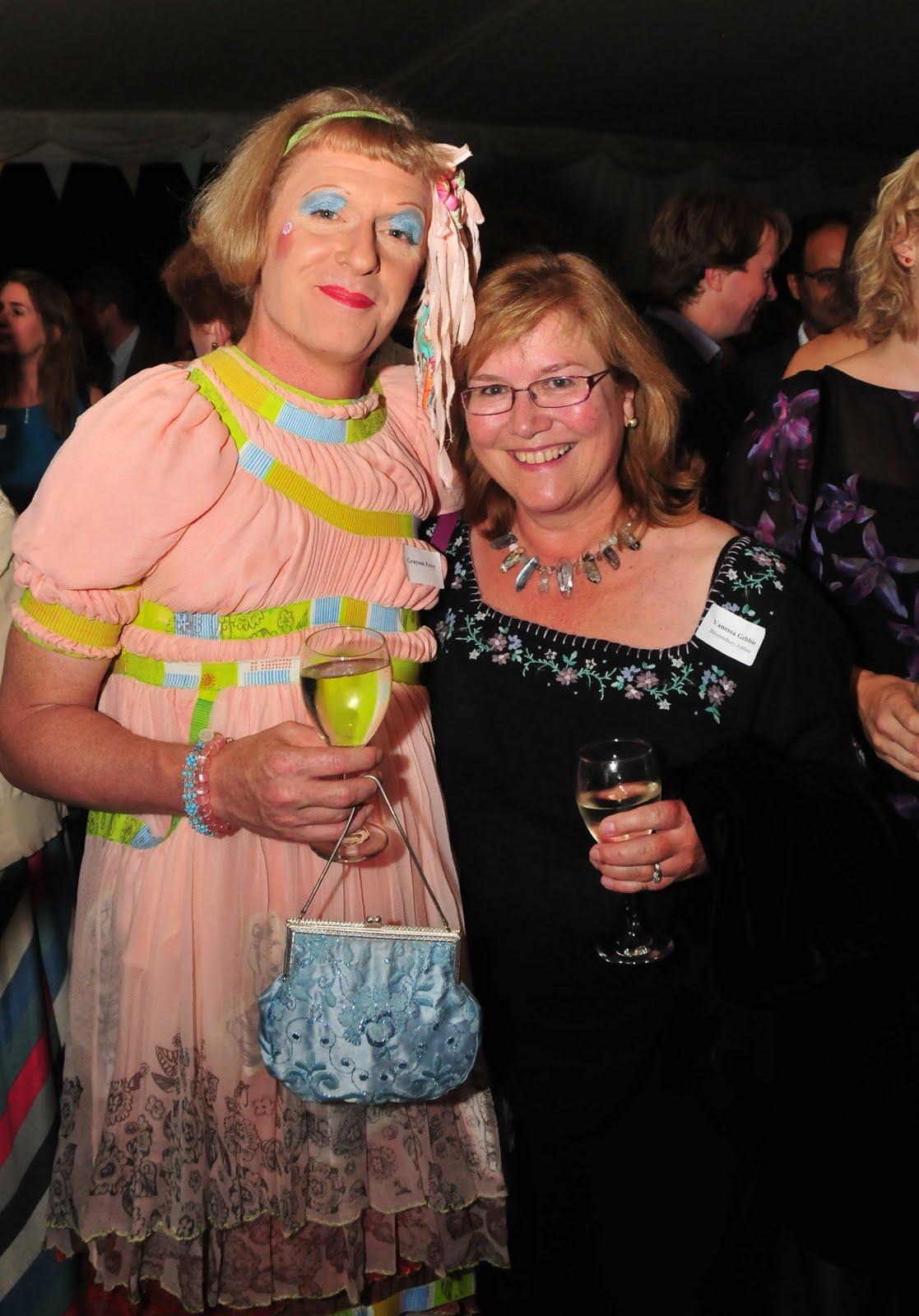
I got to meet and natter to an artist I have admired for a long time - Greyson Perry. We met at Bloomsbury's 25th Birthday bash, which, in true style, covered the centre of Bedford Square in London in a marquee and filled it with over 1000 authors past present and future, publishers, agents, printers, literary reviewers, illustrators, and oodles more.

For Dutch courage, the lovely Claire King met me at The New Cavendish Club (I have associate membership thanks to my membership of SWWJ) and we downed a G and T before heading off eastwards in a taxi. I regressed, unashamedly, into a teenage celeb-spotter. Lovely to see my buddy Andrew, my agent Euan, my editor Helen, the paperback editor Tram-Anh (which means Wise One), and to meet Jane Rusbridge and Precious Williams for the first time, Marika Cobbold for the second time, Selma Dabbagh for the at least third time, Jeremy Osborne of Sweet Talk for the first time, to eat finger food by the best (including haggis in a roll - which for a hot evening, was amazing!) -drink endless champagne. Happy Birthday Bloomsbury, and here's to the next 25. Who knows, with luck and a following wind, I'll be there at the 50th. In my zimmer.
,
And here is the paperback cover sent to me by Tram-Anh. With a few tweaks, including adding Rhymney Beers to the hotel signs, its smashing!

Monday, 19 September 2011

TILTON HOUSE WEEKEND RETREAT FOR WOMEN WRITERS


RECIPE FOR A GOOD WEEKEND.
Take one very beautiful house in a lovely garden, hidden away at the foot of the South Downs, once the home of the economist Maynard Keynes and his Russian ballerina wife.


Add eleven women writers, of all sorts. Here's ten of them - Beginners to established, poets and story-writers, novelists and playwrights. Performance workers and editors. Journalists and imaginers...
Mix gently.
Talke a gifted chef called John, who runs a vegan/vegetarian catering company called Cashew Catering, (not that many of us were even vegetarians, but happy to try...!) and a lovely farmhouse kitchen in which to experience zingy healthy tastes, like stuffed mushrooms, or fruit or savoury crumbles topped with nuts and seeds, fresh soups,

extraordinary brown breads, pretty salads topped with flower petals and whole flowers. Cous cous with roast vegetables, ad inf. Stir the writers in gently, with a large glass of something relaxing, white, red or maybe rose.
Put a writing tutor in the centre, who knows what its like to fight for time to write in among the other calls on one's time - partners, kids, other family, friends, housework ("What housework?" my family are yelling...) Who knows how hard it is sometimes to remember what a gift it is to be able to create.


And who knows how important it is to be given permission to do exactly what you need to do creatively - and to be challenged when you're ready and not before, shifted out of your comfort zone when you want to be challenged.
Leave to warm for 48 hours - two days and nights. At intervals, add in a workshop - with the best writing exercises the tutor knows, appropriate for everyone. Visualisations to open up new scenarios, voices, emotions. Word games to create new connections. Scenarios full of details left out, for you to fill in - to help create living, breathing characters. Maybe a Bedtime Story by the fire at the end of the day to lull you to sleep (or not, if it is funny...).
Throw in a private tour round Charleston Farmhouse, home of the Bloomsbury set, Virginia Woolf's sister Vanessa Bell, Duncan Grant, Roger Fry and later on Clive Bell.
Point writers in the direction of Berwick Church, where the Bloomsbury crowd created murals in which every face is one of their friends, or neighbours. Or go for a walk through the farmyard, skirting the fields, along the old coach road, across more fields, and back home.
Finally, add inspiring guests who will share a meal, and wine, and talk to us, then answer questions until the questions run out. Firstly, a successful female poly-talented writer actress and director, playwright, and novelist, Carole Hayman, she of the stunning Pre-Raphaelite hair, and co-creator of 'Ladies of Letters', among other things. (Who tells us that Fay Weldon reckons you ought to be able to write your novel in 3 weeks if you focus hard enough). Secondly, a top publisher. Helen Garnons-Williams, Editorial Director of Bloomsbury, to give us the insiders' view of the publishing world. What commissioning editors are looking for. The huge benefits of having an agent. And the topsy-turvy world that is e-books. (See us all chatting before Sunday lunch, on the lawn, in one of the first pics above.)

Check for consistency. Be told that every participant had achieved or surpassed their personal objectives. Feel very delighted, and enjoy all the new friendships made, the shared inspirations, the hopes to met again soon.
Retire to bed on the third day absolutely knackered.

----------
Leftovers can be enjoyed, gently warmed for a few days. Especially while reading unsolicited feedback sent to New Writing South, like these snippets:

Just a note to say how much I (and, I am sure, everyone) enjoyed this last weekend at Tilton. It was easily the best writing event I have attended in all respects and I came away inspired!


Just a quick thank you for a wonderful writing retreat - I think that you and Vanessa gauged it perfectly - well done!


I had no idea that this was the first writing retreat that New Writing South had organised - it all looked very professional but I'm sure there was a lot of hard work involved.
It was the best writing workshop I've been on - inspiring tutor, perfect setting, delicious and healthy food and lots of time and space to write. I feel as if I've come back with a treasure trove of energy and ideas to keep me going through the winter.
So thank you.

Thursday, 15 September 2011

Look! My book!


That's all - just a whole box of the beautiful Coward's Tales...sigh. Its gorgeous. Silvery shining leaves, feathers, river, a village and mountain, statue, old man and boy. And a rather stunning fish.
(Thanks to Stephen Moran for turning the pic round, otherwise you'd have had to look at the book backwards... like this...!
heee!
I'm allowed to be excited - 'The Coward's Tale' is on the Bookseller's Choice list for November, thanks to a nomination from the lovely people at the Torbay Bookshop. And it's been reviewed by A N Wilson for a future issue of Reader's Digest... positively, one gathers.

Anam Cara is booked for late Jan early Feb - I need to write!

Monday, 12 September 2011

INTERVIEW WITH NEIL BLOWER - THE REAL TOMMY ATKINS


Neil Blower.

My second short story collection, 'Storm Warning' was written for my father, a man who was awarded the MC in WWII. He died in May, at 95. Dad was naturally a gentle man, and he never quite got over some of the events he'd witnessed and had to take part in. I wanted to explore in fiction the aftershocks of conflict, to show the different ways in which those caught up in conflict of many kinds can be changed - and I have been pleased with the response to my book.
But then I heard on Twitter of the novelist Neil Blower, who goes under the name @realtommyatkins - a guy who has not only experienced conflict first hand, but who has written a novel partly in an attempt to combat the after-effects - and I badly wanted to read his book. Thanks very much to the publishers for sending me a copy.
'Shell Shock, Diary of Tommy Atkins' is published by Firestep Press, and the publisher says this:
This short, diary-style novel, by a British army veteran chronicles the difficulties faced by Tommy, a 23-year-old squaddie, as he desperately tries to conquer post traumatic stress disorder (PTSD) – shell shock. His over-emotional responses to the stresses of everyday life – post-office queues, a trip to Ikea, and his relationship with his family and girlfriend – eventually lead to alienation and suicidal urges.
Told in the vernacular, with humour and personal understanding, the story highlights the work of the Charity Combat Stress in rehabilitating returning troops.


'Shell Shock, Diary of Tommy Atkins' comes out from Firestep Press on October 1st. On Firestep's website you can read the very strong endorsements this book has already received from senior figures in the forces. It is a short novel, and certainly not sweet. It is a quick read, and one that most readers will find hard to forget. It is an important novel, and I'd urge readers of this blog to go off and buy it - you are also giving a donation to a fabulously worthwhile charity, Combat Stress. But more of that later.
Shell Shock's main character is Tommy Atkins - named of course after the nickname given to British soldiers in WWI.But this is not then, it is now. very much so. This particular Tommy Atkins, in his early 20s, has been discharged from the Army suffering from Post Traumatic Stress Disorder. He goes home to parents whose marriage is fragile - and to a girlfriend, Shell, who adores him and is glad to have him back. The novel is set, as the title suggests, like a diary, and very quickly I began to experience that strange voyeuristic feeling - 'I shouldn't be reading this' - as if I really was reading something intensely private. Tommy chronicles his every day experiences - his attempts to find employment, his working relationships, his relationship with Shell, and with his parents, the ups and downs that gradually become overwhelming. Is it weak to admit I was in tears in places? I don't think so.
As a fellow writer, I was absolutely captivated by the voice. It is clear, unforced, strong as hell, natural and absolutely believable, just the voice of an ordinary guy caught in an extraordinary situation -that's why I sank so easily into the role of observer, I think.
I knew a little about PTSD. Among other things, my own writing tutor suffered from this debilitating, hidden syndrome - hidden because nothing 'shows' - we like our injured people to wear bandages and splints so we can see where the trouble is, don't we? And my own father must have suffered for sixty years from a mild form of the same thing, on and off - something that got in the way of his everyday life after he left the Army in 1946. And in those days there was no help - nothing was recognised. You were expected to get on with things. Which he did. But my goodness - life could have been so much better for those men...
Now, having read 'Shell Shock', having got to know 'Tommy Atkins' through his diary, and the raw honesty with which Blower portrays his character, I can recognise so many things which affected my Dad - and I've never really put two and two together in such a clear way.
Reading round the subject - somewhere I read Neil Blower's acknowledgement that this is not a 'literary' novel - as if it ever ought to have been. Forcing it into a literary jacket would have been absolutely the wrong thing to do. I appreciate what he's done, I have huge respect for this rather special novel, which will not be easily pigeonholed, thank heavens. I also discovered that he is doing a degree - and that he has recently discovered that he is both dyslexic, and suffers from a condition on the autism spectrum.

ME: Neil was kind enough to natter to me for the blog - through his publicist. So thanks, Neil! First, can you give us a bit of background about yourself, your time in the forces and since?

NEIL:
I joined the army in 1999 and served five years with the Royal Tank Regiment, taking part in operations in Kosovo and the Iraq war. After I left the army I did a number of minimum wage jobs including security which I stayed doing until I decided to go to University. The thing about working in security is that over a 12 hour shift, especially nights, you have a lot of time to kill, so I read. I read books on everything from politics to history to physics, I'd always been a keen reader but mostly fiction. I wanted to know everything about everything, I'm convinced this has something to do with being around death and violence because before Iraq I had never really been interested in academic pursuits.


ME: I very much enjoyed reading 'Shell Shock, the Diary of Tommy Atkins' - I also found it very moving. What do you want your readers to feel after they've read your novel?

NEIL:
I hope they don't think it's garbage ha ha. Seriously though, if people read it and have a better understanding of what our soldiers have to face, not just at war but when they come home as well then I'd be happy.


ME: I read that you've suffered from PTSD yourself, and were advised to 'do something creative' to combat the stress. Was it a deliberate decision on your part to write fiction, as opposed to non-fiction/memoir? If so, why?

NEIL:
Yes it was very much a deliberate decision. I've always been into books since childhood. Then after I left the army and was told that creativity may help my condition that was the my first thought, I also played about with screenwriting. It started off as a hobby really, then I thought, maybe I could do it for real and someday get published, then it became an ambition and not to sound like a cliche, a dream. There's lots of things I want to write about, not just war or the military, but I think for me it's a good place to start.


ME: 'Shell Shock' is a real eye-opener. Two scenes in particular have stayed with me - firstly, when the Army doctor tells Tommy he's no longer under his care, almost 'abandoning' him. And second, when Shell's friends ask about killing. Both those scenes seem to underline the huge gulf between Tommy and others. Can you talk a bit about writing those scenes?

NEIL:
Well the bit about the Doctor is true, once you leave the forces that's it. You are someone else's problem. It's nothing personal, that's just the way it is. Like with the married accommodation, once you leave - you have to move out. Like many things in our society, it;s the rules that need changing. And as for the question about killing, I've had that a number of times "did you ever kill anyone?" I think with our general perception of war this is an obvious question, albeit a very insensitive and sometimes ignorant one. The vast majority of people will never, ever be put in a situation where they will have to end the life of another human being and I think this is why people ask. Also it has been glamourised and romanticised to a certain degree on TV and in films. In the new Bond films and the Bourne Franchise for example - the hero is a killer and has to live with it. I did write those scenes to highlight the gulf between soldiers and civilians.


ME: As I said on Twitter, I think Shell Shock is an 'important' novel. Were you aware of its importance as you were writing it - and if so did that help or hinder?

NEIL:
As I was writing it, I just wanted to make it as good and truthful as possible (and finish it). It was only after we started to get feedback and reviews that its importance crossed my mind and it's not really for me to say. I'd be very, very proud if it is considered an important novel though.


ME: You're doing a degree at the moment, I think, in English Lit/Creative writing? What's that like?

NEIL:
I'm really enjoying it, the learning feeds into my work, knowing what's gone before and being in that environment has really helped not only my creative side but my knowledge base as well. I'm the first person in my family to ever go to University so I'm proud just to be there.


ME: Tell me a bit about the dyslexia and the autism spectrum issue. If these had been picked up earlier on what difference would that have made?

NEIL:
I was absolutely mortified when I found out. I wanted to be a published author - how would this ever happen now? But then I thought, you know what, I can do this, it will happen. I don't think it would have made a difference if it was picked up earlier, I'd not really been in a situation where it mattered, it just means I see things differently than other people that's all.


ME: I hadn't heard of Combat Stress, the charity and I bet I'm not alone. I gather a not insubstantial donation (£1) is given to the charity for each copy of your novel that is sold...Would you like to say something about it and the work it does?

NEIL:
Combat Stress do a fantastic job. I think they are starting to get a higher profile. But I also think that over the coming decade PTSD will be a major issue in this country, the amount of people who have served in Iraq and Afghanistan coupled with the intensity of the fighting means that the number of PTSD sufferers will go through the roof and this in turn affects the NHS, welfare, crime, so it's important we recognise the condition and the organisations that can help.


ME: Anything else you'd like to natter about?

NEIL:
Ha ha, there's lots I could talk about but I'll save that for my novels. I just hope people enjoy Shell Shock and get something from it. And for in depth info about PTSD please see the website of Combat Stress .


ME Thanks Neil, very much, and loads of good luck with 'Shell Shock', and the next piece of work.

--------------------

Other reviews of 'Shell Shock' include this, on rearparty.co.uk

Copies of 'Shell Shock - the Diary of Tommy Atkins' can be bought from the usual suspects, including the Publisher, and Amazon-HERE. Don't forget, you are also giving a donation to Combat Stress, who are doing a fantastic and difficult job...

-------------------

Neil Blower is a British author, screenwriter and novelist based in Manchester.
He joined the British army when he left school and served five years with the Royal Tank Regiment. Serving on operations in Kosovo and the 2003 Invasion of Iraq.
Neil is currently studying for a degree in English literature and creative writing at the university of Salford.
His first book - Shell Shock: The diary of Tommy Atkins will be released in paperback October 2011 by Firestep Press - an imprint of Firestep publishing.
He is now working on his second book - My subject is war. A collection of short stories exploring the realities of contemporary conflict.
Neil is an avid reader, his favourite writers being Hemingway, James Joyce and Joseph Conrad.
He goes to the gym regularly and boxed in the army and is a big fight fan. He is also a big fan of film, anything from blockbusters to indie films. He is also a keen skier.
Neil is engaged to married to his partner of eight years Samantha, they live in Manchester with their young son.


-------------

And finally -having read this book, and talked with Neil, I decided to give all royalties from 'Storm Warning' to Combat Stress.

Friday, 2 September 2011

A week of #StoryGym


Last time I was away from Internet for a while, writers Tania Hershman and Claire King kindly stepped into the breach and invented suitably interesting prompts for the daily #StoryGym workout on Twitter, for those writers who want to.
Away again, so here's a week or so's worth just for fun!

1. Caught in the eye of the storm, carrying a child...

2. What was in the suitcase left on platform 12...

3. Her man the poet, her man the liar...

4. They meet in The George at Stamford, by mistake...

5. Supper served in a petri dish...

6. A small explosion in the garden shed...

7. He climbed to the top of the highest hill and howled...

8. "Tell me why the grass is green," he said, chewing his nails...

9. What was behind you when you looked in the mirror...


Have fun!

Saturday, 27 August 2011

ARVON THEATRE COURSE, THE HURST, 15 – 20 August.


What a busy, amazing week! Here are a few notes, scribbled hastily on site, when I wasn't either creating the next stage sensation (!!) nattering with the other students,reading, walking, eating, drinking or sleeping...
Tutors: Laura Wade, a highly successful playwright, and
Ola Animashawun from the Royal Court Theatre, who also runs Euphoric Ink, check it out - a hotspot for tuition and play development ...Here is his short intro to playwriting, courtesy of the BBC

The week went like this:
MONDAY: A long drive from Sussex. Correction. A long long drive from Sussex. (5 hrs including 2 stops.) My room, a single study-bedroom named after Wilfred Owen is in The Clock House, (the social hub of The Hurst) and has the most wonderful view.
We are fifteen students, a good mix of male and female, and of all ages. Most have already written plays in one shape or another. I haven’t. Unless you count the play I almost got expelled from school for, in early 1066 – but let’s not go there.
The Hurst is looking really lovely – I was last here in late 2007 on a fiction course – the place feels familiar, the subject not at all – I am uncomfortably at sea.
The first dinner is cooked for us – curry, fruit salad. After tonight we will be cooking dinner ourselves, in teams of four. You wash up on the night before you cook, and I notice the first difference between now and 2007. Washing up is much more of a chore – they have taken away the dish-washer.
After washing up is a Health and Safety talk, followed by a ‘breaking the ice’ session with the tutors, Laura Wade and Ola Animashawun, both of whom seem very nice, supportive, fun and full of info.
Bed early, in Wilfred Owen. This is oddly appropriate, as my play has to do with WWI. Spooky!


TUESDAY: Workshops with both tutors are held each day from 10 am to 1 pm – today's is a mix of writing exercises, warm-ups, interrogating our thoughts and our initial ideas for plays. It seems different to the fiction course, in that there is no sharing of our own creative ideas, the plays we are wishing to write - unless someone volunteers what they are working on. We are actually encouraged not to share...good for them, much kinder!
Interestingly, we talk about premise, setting the ‘message’ of our as yet unwritten plays into a single sentence that encompasses character, action and outcome. The fourth element of premise is the writer’s passion for the subject...
It seems that there is far more advance planning, at least as regards structural stuff, and premise, - less to discover as you write, only that might be a bad perception.
During the afternoon, we have free time to write, or to do whatever we like. I take a copy of Caryl Churchill’s ‘Far Away’ into the grounds, find a seat with the most fabulous view over Houseman’s rolling hills, and read it at least three times. A real eye-opener. Surreal, strong, wacky and frightening. Love it.
I start my play. Well, I write some dialogue between two characters, before wondering if I am writing the right play. Then I feel that this must be the good old imp on the shoulder who tries to stop plays getting written as well as stories and novels. I have a kip and try to ignore him.
Join in the cooking, and make a very boozy tira misu for eighteen. There is a special guest this evening, April de Angelis, who, if I was more into the world of play writing, I would realise was a very well known and revered figure. She is very funny, generous, interesting and entertaining about the work she has done for about thirty years! The best thing she says is that she writes to discover – sets out with minimal idea of what’s going to happen. I sigh with relief. Here's a link to some of her plays, from Faber and Faber.
But I also realise that there has been talk several times today about young writers – excitement about young writers. Talk of plays written for older actresses – but no talk of older women starting out as writers of plays...ho hum. C'est la vie. As with fiction, I guess you just have to be as good as you can be, and hope for a modicum of luck!
I revise a poem before bed.
Hornets invade the bathroom outside Wilfred Owen, attracted to the light. They are vast – never seen these things before. Real four-engine jobs. It transpires there is a nest and the Hornet-Exterminators of Clun have been out once already. They can’t be very good at it. I chew my toothbrush instead of brushing properly. Sacrilege.

WEDNESDAY: Today’s workshop is an introduction to the structure of plays. We look in some depth at Caryl Churchill’s ‘Far Away’, which I liked very much. We dissect the play, look at its unusual structure, see how it is absolutely right. We do a great exercise, looking at the life of Michael Jackson, and deciding how we would individually create a play about his life. It quickly becomes obvious that you need to be aware of the premise of your play before you can attempt to write it...and once I’ve realised that, I invent a play of great genius set during the inquest into his death, with Elizabeth Taylor as one of the major characters...Broadway here I come. Another eye-opener.
We are asked to consider our own main characters, for tomorrow’s session – and possible structural decisions.
I have my first one to one tutorial this afternoon, with Ola. I am now able to articulate the premise of my play, and the setting, and when it takes place. It is met with approval, I am given loads of encouragement, and when I ask, am warned of possible pitfalls.
I spend a happy couple of hours on ‘my’ seat in the grounds, reading ‘Blood Wedding’ by Lorca. Then had a lovely walk on my own up out of the grounds on to a track through hills, and farmland – this really is the most gorgeous countryside. Clun, the village nearby is meant to be one of the quietest places in the UK. Apparently, although A E Houseman wrote A Shropshire Lad in the 1890s – his poems were among the most popular for WWI soldiers to take away to war, to remind them of England...although for many, it must have been an England they had no experience of. Lots of thinking about my play, en route.

Tonight, the tutors are in charge of the evening’s event – Laura goes first, helped by Simon, one of the students, and they read us a play she has been commissioned to write by the Australian Philharmonic Orchestra, based on the Kreutzer Sonatas of Beethoven and Janacek, and Tolstoy’s novella of the same name. And Ola, who does not write plays himself, does a sit-down comic turn, introducing two articles he has written – one about how to read plays –fascinating! Loads of time for questions and natter.
Hornets are back after dark - on the landing outside Wilfred, holding a loud conversation about light fitments. Yikes. I leave them to it. (No, they aren't quite that big. That is a queen hornet, apparently.)

THURSDAY: The workshops are on characterisation. Two thirds of the morning is spent on exercises and games, all of which feed into the recognition and development of character, the importance of a character’s objectives and obstacles to their achievement thereof. In one game, called ‘Touch and Go’ – we are all in a circle round one person, crouching in the centre. We have to touch them, and wait for the instruction ‘Go!’ and run – the person in the centre has to try to ‘catch’ our hands before we do so. If she succeeds, whoever is caught joins them in the centre. Much laughter and tension – and afterwards, we analyse the major components of the game, and come to the conclusion they are the major elements of drama. Tension, progression, anticipation, collaboration, using the senses...and so on. (Delighted to find I can still bend in the middle and kneel on the floor...) Another walk...
I begin to write my play in earnest during the afternoon, finding the voice of my main character, and selecting a scene from what will be close to the end – I start to write a short soliloquy to leave for the final evening’s celebration, tomorrow. I won’t be there, sadly, as a family holiday starting Saturday means I have to get back home tomorrow evening.
I have my second one-to-one tutorial, this time with Laura Wade, who asks some very pertinent questions, and opens up all sorts of possibilities for my main character.
Most of the team go off to the pub in the evening, a few of us don’t – me included. Spend the evening writing that short soliloquy - what a goodie two shoes. But it definitely isn’t easy, this play writing stuff. I struggle to get it to say what I want to, in the right way.

Hornets? Yup. In the kitchen...We persuade them into the back pantry and lock the door on them. The Hurst is a beautiful estate, way out in the country. There are old buildings aplenty, several old residential/smallholding properties, and too many ancient trees to count. A few hornets is nothing! Its a privilege to be here.

FRIDAY: This morning, we take a look at dialogue. There I was thinking it is approached the same way as direct speech in prose – again, I’m way off beam. We do an interesting exercise (again – they were all interesting, actually!) in which we recall phrases we associate with someone we know well and write them down. Someone else has to guess who the person is/was. Good game! Then we chat to our main character – us, we, the playwrights. (Or not...) and that really was good. Both voice-wise, and also for attitude, personality. A focus on sub-text came next, and an in-depth analysis of Scene 1 of ‘Far Away’ – useful, eye-opening stuff. Then we have a look at classic play structures, and the last half hour or so is spent on a sweep-up Q&A session.

I have to leave after lunch, sadly, as I’m due at Heathrow early for the start of a family holiday in the morning, and don’t fancy getting up in the early hours to do the drive. I have to leave a thank you note for the tutors – and also I leave a couple of pages of script with Nick, a 20-year-old fellow student who has done some acting, and is exactly the right age for my main character. He has very kindly agreed to read for me this evening – I am sad to miss this occasion, very much. It will be the only chance to hear what sort of things some of the others have been working on.
I leave at 2.30 pm. I forget it is an August Friday afternoon, and get stuck on the M 42, discover you can’t get off and then on to the M 40 easily – despite it being about half an inch away on my map. I visit the outskirts of Stratford, then Warwick, entirely by mistake, eat Kentucky Fried Chicken at some point, drive on autopilot and get home at 10.15.

As I go to sleep I wonder if the hornets are outside Wilfred’s door again.

Overall.
I was on autopilot because I hadn’t realised just how tired I was. It has been a really fantastic week at The Hurst - it’s been challenging, interesting, fun and inspirational. And a lot of hard work – right out of the comfort zone, but the feeling of being at sea got better as the course progressed! The company has been excellent, the tutors absolutely great. I’ve learned a lot, I hope - and now it’s down to me.
One of the unexpected benefits of the course was rediscovering how scary it can be for a student on a writing course, and how vulnerable you can feel. I hadn’t forgotten – but it is always useful to be reminded...


Sunday, 14 August 2011

PLAYS, POETRY

I'm off to The Hurst on a play-writing course with the rather lovely Arvon Foundation - well out of my comfort zone. I shall report how I got on...
Equally out of the comfort zone, but something that occasionally works, is poetry. I received my contributor's copy of 'Envoi' last week - among the first tentative steps into print for my poems. What I can't work out is this - why is it harder to share a poem than it is a flash, a story? But it is! So in order to knock the corners off that one - here is one of my Envoi poems, and its genesis.
'Beara litany' was written at Anam Cara writers' and artists' retreat after a visit from Irish poet Paddy Bushe (that link is one of many..), who gave a reading to my short story students one evening. It was an extraordinary experience. Just a handful of us and this real live poet! I asked the students to respond to the reading before they slept - however they wished. And I wouldn't ask another writer to do something I wouldn't do myself, so...sat up in bed at midnight to write something. Nothing came, I was so tired - then a few lines from one of Paddy's pieces did their work.
He'd written a response to the ancient Song of Amergin, which in turn is taken from one of the most ancient Irish texts - and which contains something that sounds like a mantra - the opening four or five lines of his echoed that mantra - quite mesmerising.

This is the song itself.

Am gaeth i m-muir
Am tond trethan
Am fuaim mara
Am dam secht ndirend
Am séig i n-aill
Am dér gréne
Am cain lubai
Am torc ar gail
Am he i l-lind
Am loch i m-maig
Am brí a ndai
Am bri i fodb fras feochtu
Am dé delbas do chind codnu
Coiche nod gleith clochur slébe
Cia on co tagair aesa éscai
Cia du i l-laig fuiniud gréne
Cia beir buar o thig tethrach
Cia buar tethrach tibi
Cia dám, cia dé delbas faebru a ndind ailsiu
Cáinte im gai, cainte gaithe

Then there was Paddy's response, in English, a gorgeous piece to listen to. Then my response to his, below, written by a rather tired writer (often the best time to write - we're too tired to self-censor...). I read these lines back next day, and liked them. They encompass all those things I love about the place I go to write, the countryside, its myths and legends, its hard history, wildlife in abundance. No wonder the early settlers found it impossible to turn round and set sail again.:


Beara litany
After a reading by Paddy Bushe


Am the heron’s hunchbacked flight
Am the song of the tagged sea-eagle
Am the roots of Ogham stones
Am horizon’s blurred conjoining
Am a hundred shades of shadow
Am the sparrowhawk’s cry
Am the cattle on the strand
Am the gannet’s lightning psalm
Am skeins of smoke over Coulagh Bay
Am the language of the turf
Am the grieving man at dawn
Am the rain’s punctuation
Am the stubbornness of the Hag
Am attrition of wave and wind
Am the strength of limpets on the praying rocks
Am Kilcatherine’s slumbers
Am the dance of boulders
Am the fraying noose of history
Am the mourning of the sparrows
Am the ocean’s ceaseless hymning


.
Published by Envoi, August 2011.

Thursday, 11 August 2011

WHAT THEY SAY ABOUT THE COWARD'S TALE...


Maggie Gee says:

“Tender and gripping – a brilliantly written epic”


Salena Godden says:

“A Russian doll of a book, layers within layers, histories, ghosts, superstitions and secrets. This book shines a light through the material of human nature, our successes and failings, strengths and weaknesses, pride and vanity and love. The Coward’s Tale is timeless. Storytelling at its best. It's a wonderful read.”


Damian Barr says:

“A rich seam of fables conjuring a community bound together by tragedy and secrets. Everyone knows something about someone but only one man knows everything about everyone. The Coward's own tale is the bravest of all.”


Charles Lambert says:

"The unlikely but entirely legitimate child of Gabriel Garcia Marquez and Dylan Thomas, The Coward's Tale invests everyday life with a quality at once whimsical and heroic."


Mari Strachan says:

“A lovely book. It is compulsively readable. Her poetic writing is meticulous in its apt and close observation. She writes about her flawed characters with such warmth and kindness, making of them archetypal characters hewn out of the history of small towns the world over.”


---------

Thank you very much indeed to Maggie, Salena, Damian, Charles and Mari for reading The Coward, and for saying such gorgeous things.

Friday, 5 August 2011

AN INTERVIEW WITH CLARE HEY OF SHORTFIRE PRESS -'Taking the story out of the collection...'


Shortfire Press is a digital-only publisher specialising in short stories from new & established authors. Its founder, owner, editor and general good egg is Clare Hey, who I met at ShortStoryVille in Bristol a few weeks back - and between us we cooked up an interview swap. So here is Clare - telling you about herself, about her press, about her other day job as freelance fiction editor working at some great publishing houses...she is quite a power-house! Shortfire has exclusive short stories by some stunning writers, among them Niven Govinden, Tiffany Murray, Salena Godden, Sarah Hilary, all carefully selected for your delectation. It ain't easy to join that list - your work has to really sparkle. But I asked Clare to give writers, especially those who may be new to submitting, a few tips...


Welcome to the blog, Clare. Firstly, could you tell us a bit about yourself?
I'm an editor by day and a bitter-drinking Yorkshire lass by night. I moved to London ten years ago to go to university and have been here ever since, working in publishing since I graduated. My first job was at HarperCollins, where I stayed for eight years, working my way up to Senior Editor, commissioning some great books. I left there eighteen months ago and have since been a freelance editor for lots of big publishers, and am currently working at Simon & Schuster as a fiction editor. Oh, and running Shortfire Press too!

Tell us about Shortfire!
We are an independent digital-only short story publishing house. We specialise in stories from both début and more established authors, and boast some amazing award-winning writers on the site. The thing we do differently is that each story is downloadable separately, so you can try just one story for just 99p. All our stories are exclusive to us and brand new - and we hope the site is a place for readers to discover the best writers around today.

What gave you the idea for Shortfire Press?
The idea came about as I've always been a fan of short stories and I suspected the advent of digital publishing would offer new opportunities for short stories. So, in a moment of inspiration whilst on holiday I decided to marry the two and to take the story out of the collection, if you like; to make stories available one by one for 99p. The mission is to bring the short story to everyone!

How did you select the very first story, and what was it?
I launched with three short stories: 'Topple' by Laura Dockrill, 'Summer in the City' by Nadifa Mohamed and 'It Snows they Say on the Sea' by Elizabeth Jenner. I asked Laura and Nadifa to write stories for me as I'd worked with them both before (I edited Laura's amazing short story collection Echoes, and I commissioned and edited Nadifa's Black Mamba Boy, which went on to be included in pretty much every shortlist going - which was nice!). Elizabeth's story came to me through a mutual friend, Ben Johncock, who said it was the best story he'd ever read. I hear this a lot and was sceptical, but he wasn't wrong. Elizabeth's story is now our bestselling story - and the fact it was the first piece of writing she's ever had published makes it even more special.

Tell us about the subs process - and your selection process.
I'm looking for amazing writing, great plots, evocative settings, and a freshness of voice. I want our readers to be able to trust that every story they download from Shortfire will be a corker, so I am pretty picky in choosing which stories to go for. I'm happy to take on a writer who is not well known - I want to discover the writers of tomorrow as well as featuring the best writers of today. For more details about the ins and outs of submitting, visit the subs info on Shortfire's website.


What makes the short story so perfect for this - length of course, but what else?
I feel like short stories are undergoing a renaissance of a sort and digital publishing is part of that. They are ideal for reading when you have a set amount of time - a train journey, or a lunch break - and they are just great full stop! I don't really buy into this whole idea that people have less time so they want to read shorter works. But whatever brings people to Shortfire, I'm happy!

I love discovering work from new writers - if there is a new writer who is a bit scared of submitting to you, (and indeed anywhere good) what would you say to them?
I hope no one would be scared of submitting to us! I would say make sure your story is as perfect as you can get it. Then be bold! Yes, you'll get rejections, but hopefully along the way you'll get some useful feedback. But do your research. Make sure you read the submissions guidelines and that your story fits what the publisher is looking for. If they say they don't do SF, then don't submit SF - the editor isn't going to look at it and think, Well, this is not what we're looking for but it's so amazing I'm going to turn my publishing house upside down to accommodate it. And read some of the stuff the publisher does publish - it's the best way to find out what they are looking for. But, in the end just go for it!

What are you reading in your spare time?
One of the best things about my job is the free books so I always have a massive to-read pile. At the moment I'm reading Helen Oyeyemi's new collection of stories, Mr Fox - it's so original and impressive. I've got Seeing Stars by Simon Armitage for my hols (I've got a bit of a crush on him), as well as The Memory of Love by Aminatta Forna and The Lacuna by Barbara Kingsolver. That should keep me going for a while!

I loved Oyeyemi's Mr Fox. I devoured it in a train journey and a morning, and it's one of those books I can't wait to read again. There's so much in it...but back to you! Anything else you'd like to natter about!
I was once nervous about approaching a famous and rather aged writer, and was worried about what I'd talk to her about. Then someone told me that she liked to talk about the same things as the rest of us: cats, food and sex. So that's been my mantra ever since!

Love that! Do you write stories yourself?
Nope. And I hugely admire anyone who does.


Thanks Clare, for that glimpse into the world of Shortfire Press. Readers and writers of short stories - get over there to download some extraordinary pieces of work, and to check out the submission guidelines. And while you're at it, you can read my own interview, alongside others. Check out Stuart Evers...and dip into a short masterclass in short story writing, with Marcel Theroux! A veritable goldmine.